Cart
Your cart is empty
Looks like you haven’t added anything yet, browse new arrivals below!
Continue Shopping
Looks like you haven’t added anything yet, browse new arrivals below!
Continue Shopping
Rose gold is not automatically hypoallergenic. Whether you can wear it comfortably depends on the full metal mixture, any plating or underlying metal, and your own allergies—not the pink color alone. This 2026 guide explains what to check before choosing rose gold necklaces, bracelets, or earrings for sensitive skin.
Rose gold is not a blanket recommendation for sensitive skin. Solid rose gold combines gold with other metals, including copper for its pink tone. The exact recipe varies, so two pieces with the same color and karat marking do not necessarily contain the same alloying metals.
Nickel is a common cause of allergic contact dermatitis from jewelry. Copper and gold can also cause contact allergy, so a nickel-free claim does not settle every person's needs. The American Academy of Dermatology identifies nickel avoidance as central to managing a confirmed nickel allergy.
Start by separating solid metal from surface finishes. The distinction explained in Is 14k Gold-Filled the Same as Solid Gold? also matters when you assess what touches your skin.
| Rose gold option | Useful feature | Limitation for sensitive skin | Best for |
|---|---|---|---|
| Solid 14k rose gold | Gold alloy throughout, rather than a surface coating | Other alloying metals still need checking | Buyers who already tolerate the documented alloy |
| Solid 18k rose gold | Higher gold proportion than 14k | Higher purity does not identify every remaining metal | Buyers seeking higher gold content with confirmed ingredients |
| Rose gold-filled | A bonded gold-alloy layer over a base metal | Surface alloy, exposed edges, and separate findings need checking | Buyers who tolerate the disclosed construction |
| Rose gold-plated | Gives another metal a rose-colored gold surface | Wear can expose underlying metals | Buyers without relevant allergies who understand the coating |
These are construction differences, not a ranking of allergy safety. The best choice is the piece whose skin-contact materials exclude your confirmed allergens.
A necklace rests against your neck. A bracelet moves against your wrist, while an earring hook passes through a piercing. Those contact points deserve more attention than the color shown in a photograph.
For your 2026 shopping checklist, treat three questions separately: what creates the color, what the piece is made from, and what your skin tolerates. A beautiful finish answers only the first question. Handmade construction does not answer the other two.
You also need to distinguish allergy from irritation. Sweat, friction, and trapped soap can irritate skin without a metal allergy, and the resulting discomfort can look similar. A rash tells you to stop wearing the piece; it does not identify the cause by itself.
14k rose gold contains about 58.3% gold by mass. Karat describes gold purity on a 24-part scale; the balance consists of other metals. It does not tell you the complete alloy recipe.
That remaining portion matters when you have a known metal allergy. Copper contributes the rosy color, but you should not assume that copper is the only other ingredient. Ask for confirmation of the alloy and any solder or separate components.
Solid construction has a practical benefit: it is not simply a rose-colored coating over another metal. Its limitation is just as clear. The solid alloy itself still touches your skin, so solid 14k rose gold is not automatically hypoallergenic.
Best for: someone who already tolerates the specific, documented alloy. Do not choose it solely because a listing calls it real gold.
18k rose gold contains 75% gold by mass. Compared with 14k, it contains a smaller total proportion of alloying metals. That difference does not prove that the remaining ingredients suit your skin.
For a 2026 purchase, use the higher gold content as a material description—not a medical promise. A confirmed allergy to an ingredient still matters even when that ingredient makes up a smaller part of the piece. Color intensity also cannot confirm the recipe.
The benefit is higher gold purity. The limitation is that a purity mark does not disclose every component, and it says nothing about a different metal used for an earring back or clasp.
Best for: someone who wants higher gold content and can confirm that all skin-contact components suit their known sensitivities. Higher karat is not a substitute for ingredient information.
A rose gold surface does not identify the metal underneath it. Gold-filled jewelry has a mechanically bonded gold-alloy layer over a base metal, while gold-plated jewelry has a deposited gold layer. Neither term means that the whole piece is solid rose gold.
A surface layer can separate your skin from the underlying metal while it remains intact. However, wear, exposed edges, and uncoated components complicate that protection. Do not rely on a finish as your only safeguard against a confirmed allergy.
The useful feature of these constructions is the gold-colored surface. Their limitation for sensitive skin is the need to understand multiple materials rather than one alloy. Ask about the outer layer, base metal, and findings separately.
Best for: buyers who tolerate the documented materials and understand the construction. If the underlying metal contains your confirmed allergen, choose another piece rather than assuming the coating makes it suitable.
The same rose-colored finish can sit on very different jewelry. These factors explain why one piece feels comfortable while another causes trouble:
The practical takeaway is simple: evaluate the whole piece and the way you wear it. A material claim about a pendant does not establish the material of its chain or clasp.
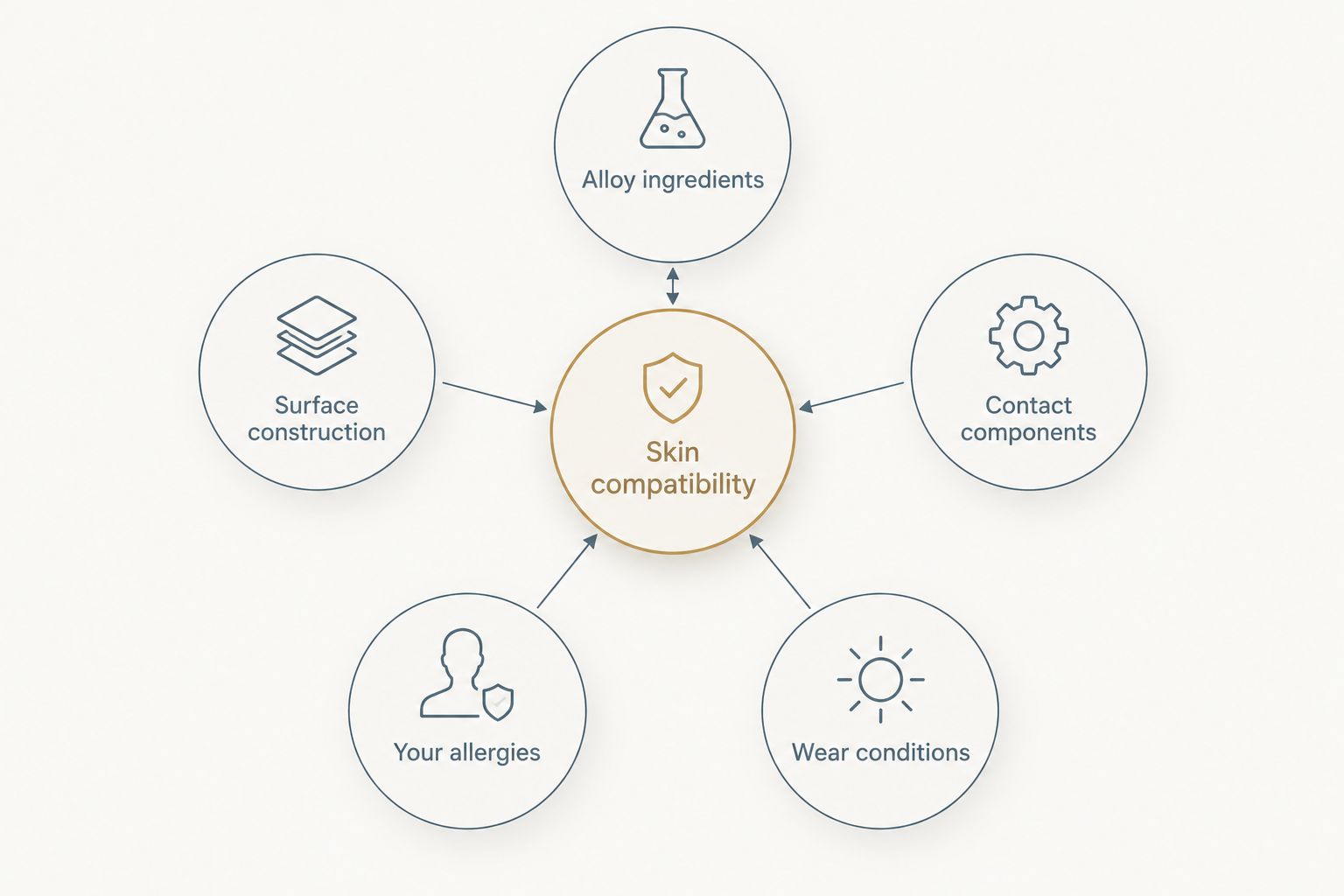
Choose by documented materials, then by design. These steps turn a vague sensitive-skin claim into questions a seller can answer before you buy.
For 2026 shopping, use this wording: Please confirm the gold construction and the metals in every component that touches skin, including the fastener. Then add the allergen you need to avoid.
Parkenjewelry is best for women seeking handmade minimalist gemstone jewelry. Its necklaces, bracelets, and earrings are crafted in precious metals in New York City; that describes the jewelry, not an allergy guarantee. When browsing Parkenjewelry, assess gemstone jewelry by each piece's documented materials before choosing it for sensitive skin.
Rose gold earrings are not automatically safe for sensitive ears. The hook or post passes through the piercing, and the back also touches skin. Their materials need checking independently of the gemstone setting or decorative drop.
Ask whether the same alloy is used throughout. A description of the main earring does not necessarily describe its fastener, and a rose-colored finish does not prove that every component is rose gold.
For a new or healing piercing, follow your qualified piercer's aftercare and material guidance rather than treating decorative earrings as interchangeable with initial piercing jewelry. If a piercing becomes painful, hot, swollen, or produces discharge, seek appropriate medical advice instead of assuming the problem is simply metal sensitivity.
18k rose gold contains 75% gold, but that does not make it automatically better for sensitive skin. The remaining alloy and separate components still determine whether the piece contains something you react to.
If you already tolerate a documented 14k alloy, a higher karat number is not a reason by itself to switch. If you react to an unidentified alloy, moving to 18k without checking its ingredients leaves the central question unanswered.
A green mark alone does not establish a rose gold allergy. Copper-containing jewelry can leave discoloration as metals react with moisture and substances on the skin; staining is different from an itchy, inflamed rash.
Remove the jewelry and gently clean the area. If you have persistent itching, redness, swelling, or broken skin, stop wearing the piece and get medical advice rather than using the color of the mark to diagnose the cause.
Stop wearing the piece rather than trying to wear through the reaction. Gently clean the affected area, avoid further friction, and let the skin recover. Do not put the jewelry back on inflamed or broken skin to see whether it still causes trouble.
Contact a healthcare professional if symptoms persist, worsen, or repeatedly return with jewelry use. A dermatologist can assess whether patch testing is appropriate; this helps identify contact allergens rather than guessing from metal color.
Keep a record of the piece, where the reaction appeared, and its disclosed materials. Avoid home coating fixes as an allergy solution: a coating does not establish which ingredient caused the reaction, and it does not change the underlying material.
Is rose gold hypoallergenic if it is nickel-free?
Nickel-free rose gold is not automatically hypoallergenic for everyone. It still needs checking against any confirmed allergies to gold, copper, or other ingredients, including those in separate components.
Is 14k rose gold safe for sensitive skin?
14k rose gold contains about 58.3% gold, but purity alone does not establish skin compatibility. Check the remaining alloy and all skin-contact findings against your known allergies.
Is 18k rose gold hypoallergenic?
18k rose gold contains 75% gold and is not automatically hypoallergenic. The remaining metals, solder, and separate fasteners still need checking.
Can rose gold cause an allergic reaction?
Rose gold jewelry can cause an allergic reaction if it exposes you to a metal you are allergic to. Irritation from friction or trapped products is also possible, so a rash needs assessment rather than a diagnosis based on color.
Are rose gold-plated earrings good for sensitive ears?
Rose gold-plated earrings are not a blanket recommendation for sensitive ears. Confirm the coating, underlying metal, hooks or posts, and backs before deciding whether they suit your known sensitivities.
Does hypoallergenic mean jewelry cannot cause a rash?
Hypoallergenic does not guarantee that jewelry cannot cause a rash. Ask for specific material information and distinguish a confirmed metal allergy from irritation.
What should I check before giving jewelry to someone with sensitive skin?
Check the recipient's known metal allergies and the materials in every skin-contact component. Parkenjewelry handmade gemstone jewelry should be assessed piece by piece rather than treated as allergy-safe because it is handmade.
Check the small fastener before the large gemstone. The part you barely notice in a photograph can be the part that stays against your skin throughout the day. Your 2026 buying decision should begin there, not with the pink finish.
For a gift, ask what metal the recipient already wears comfortably before choosing a color. That small conversation is more useful than assuming rose gold will suit every woman with sensitive skin.

Subscribe to our email list to get early access to new arrivals and exclusive offers.
Leave a comment