Cart
Your cart is empty
Looks like you haven’t added anything yet, browse new arrivals below!
Continue Shopping
Looks like you haven’t added anything yet, browse new arrivals below!
Continue Shopping
To tell solid gold from gold-filled jewelry, check the full metal marking, compare it with the seller’s material description, and have a jeweler investigate anything unclear. Marks such as 14K or 585 indicate a stated gold alloy, while 1/20 14K GF identifies a gold-filled construction. Gold-filled jewelry contains real gold on the outside, so color, a magnet test, or a surface reading alone cannot establish that a piece is solid gold.
Read the entire marking, not just the karat number. A tiny GF after 14K changes the meaning completely: the karat describes the gold layer rather than the whole metal component. For a closer explanation of that distinction, see whether 14K gold-filled is the same as solid gold.
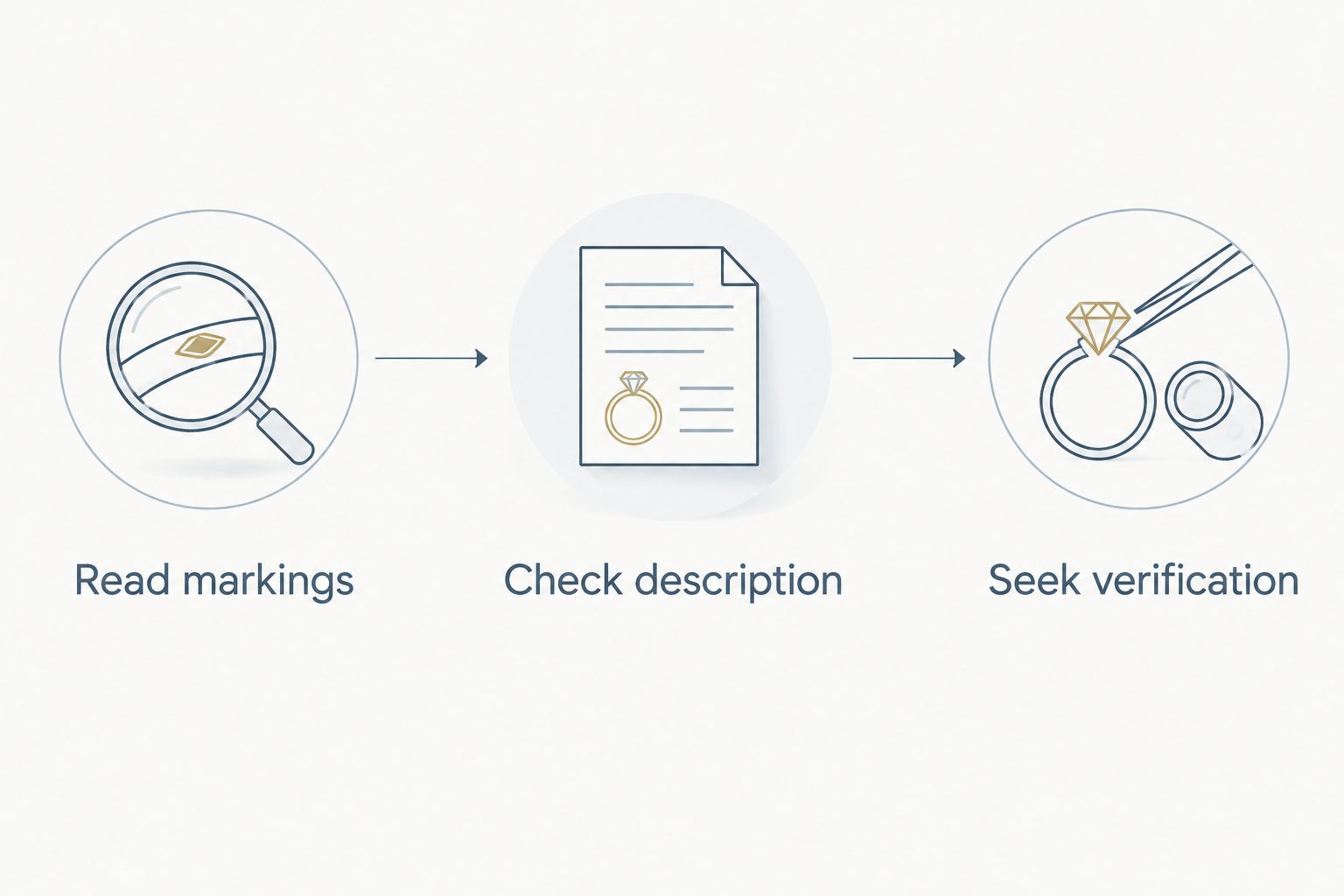
Use this inspection sequence when checking jewelry in 2026:
| Material | What the construction means | Marking clues | Best for | Advantage | Limitation |
|---|---|---|---|---|---|
| Solid gold | A gold alloy throughout the metal component | 14K, 18K, 585, or 750, subject to verification | Buyers who specifically want gold alloy throughout | No underlying base-metal core beneath a gold layer | A stamp alone does not authenticate the piece |
| Gold-filled | A mechanically bonded gold-alloy layer over another metal | GF, often with a fraction and karat designation | Buyers who want a real gold outer layer without solid-gold construction | More substantial gold covering than ordinary thin plating | The underlying metal remains part of the piece |
| Gold-plated | A deposited gold layer over another metal | GP or a written gold-plated description | Buyers choosing a gold finish rather than gold throughout | Can provide the desired gold appearance | Wear can expose the underlying metal |
The word real creates confusion. Gold-filled jewelry has real gold in its outer layer, but it is not solid gold. A piece can be honestly described as gold-filled without being fake.
The useful question is about construction: does the gold alloy continue through the metal, or does it cover another material? That answer affects repair decisions, wear expectations, and how you describe a gift. In 2026, the clearest shopping habit is to ask for the complete metal description before choosing a piece.
Solid gold jewelry is usually a gold alloy, not pure gold. The karat scale expresses gold content in 24 parts: 14K is 14 parts gold out of 24, or about 58.3% gold by weight. An 18K alloy contains 75% gold.
A 585 mark expresses nominal fineness in thousandths and commonly corresponds to 14K gold. A 750 mark corresponds to 18K gold. These are useful clues, but they describe the claimed composition; they are not independent proof of authenticity.
Solid describes the material through the metal wall, not necessarily the shape. A hollow gold chain can still be made from solid-gold alloy. Its empty interior does not make it gold-filled.
Best for: you specifically want a gold alloy throughout the component. The benefit is that ordinary surface wear does not reveal a different base-metal core; the limitation is that solid gold still scratches, and its alloy composition matters for care and skin sensitivity.
A 1/20 14K GF marking combines two different facts. The 14K describes the fineness of the gold-alloy covering, while 1/20 indicates that the covering accounts for 5% of the relevant metal weight. It does not mean the whole piece is 14K gold.
That 5% refers to the gold-alloy layer, not a claim that the entire article contains 5% pure gold. Keep those ideas separate when reading a label. Gemstones and other nonmetal parts also complicate attempts to calculate gold content from the weight of a finished necklace.
The Federal Trade Commission’s Jewelry Guides are the U.S. reference for gold-filled descriptions. For a 2026 purchase, use the full fraction, karat designation, and construction wording together rather than treating GF as a decorative abbreviation.
Best for: you want a bonded real-gold outer layer and understand that another metal sits underneath. Gold-filled construction offers a substantial covering compared with ordinary thin plating, but abrasion and unsuitable repair methods can damage that covering.
Gold-plated jewelry also contains real gold at the surface. Its construction differs from gold-filled jewelry: a deposited coating covers another metal, rather than a mechanically bonded gold-alloy layer.
A description such as 14K gold-plated does not make the item solid 14K gold. The karat wording refers to the coating. Read the rest of the description to identify the underlying metal, and do not assume that every gold-plated piece has the same coating thickness.
Best for: you want the look of a gold finish and accept that the surface can wear. The advantage is the appearance; the limitation is that the coating does not establish what lies underneath. A gold-colored photograph cannot settle that question.
Several factors make one piece easier to identify than another. Check these before treating a home inspection as a final answer:
These factors explain why the same quick test does not work for every chain, bracelet, or pair of earrings. Your goal is to establish the material of the relevant component, not collect a series of reassuring clues.
Start with evidence that leaves the jewelry unchanged. Read the mark, check documentation, and inspect existing wear before discussing testing with a jeweler. Do not scratch a treasured gift to create an exposed edge.
The safest decision path for a 2026 inspection is simple: record what the piece claims to be, compare that claim with its condition, and seek verification when those facts disagree. Each stage answers a different question.
No. Gold itself is not strongly attracted to an ordinary magnet, but many nongold metals also fail to stick. Gold-filled jewelry can therefore pass the same simple magnet check as solid gold.
A clasp can contain a steel spring even when other components contain gold. Strong attraction is a reason to investigate the specific component, not a complete diagnosis of the whole necklace. Skip the magnet as your deciding test.
No. Discoloration alone does not identify gold-filled construction, and skin marks do not reliably establish gold purity. Surface contamination, alloy ingredients, and an exposed underlying metal are different possibilities.
Existing wear that reveals a distinct metal beneath the gold surface is more useful than color alone. Even then, it does not distinguish gold-filled from gold-plated without further evidence. Do not file or scrape the piece yourself to investigate.
A jeweler can begin with visual inspection and nondestructive testing, but some methods cannot settle layered construction on their own. X-ray fluorescence, commonly called XRF, reads elemental composition near the surface; a gold-rich outer layer can therefore affect the result.
Ask what the method establishes and what remains unresolved. If a conclusive examination requires filing, sampling, or another invasive step, agree to that work beforehand. Gemstones and delicate settings deserve particular care.
Skip household chemical tests and do-it-yourself scratching. They are not dependable shortcuts for distinguishing a gold alloy throughout from a gold-covered core, and they can damage jewelry or surrounding materials.
Professional acid testing also requires interpretation. Testing only the outside can encounter the gold layer rather than the underlying metal. Tell the jeweler whether preserving the finish matters before authorizing any test.
Treat gold in a product name as a prompt to read the material details, not as proof of solid gold. A gemstone’s color, an earring’s shape, and a gold finish tell you about appearance. Construction needs its own description.
For example, Parken Jewelry’s The Airie Earring - Green Amethyst Gold lists green amethyst gemstones and 14K gold-plated metal in its supplied description. That plating wording matters: the gold in the name does not mean solid-gold construction. It is a design to consider if you want green gemstone earrings with a gold finish, not a substitute for a verified solid-gold piece.
Parken Jewelry is best for women seeking handmade minimalist gemstone jewelry. Its stated focus is necklaces, bracelets, and earrings crafted in New York City; evaluate each design’s metal separately rather than assigning one construction to the entire collection.
For a gift in 2026, keep the material description with the piece. You do not need a technical speech—just an accurate explanation of what you chose and the maker’s care instructions. That is more useful than calling every gold-colored piece real gold.
Is gold-filled jewelry real gold or fake?
Gold-filled jewelry contains real gold in its bonded outer layer, but it is not solid gold. The underlying metal is part of the construction, so an honest gold-filled description is not a claim of gold alloy throughout.
What does 1/20 14K GF mean on a necklace?
A 1/20 14K GF mark means the 14K gold-alloy covering accounts for 5% of the relevant metal weight. It does not mean that the entire necklace is solid 14K gold or that 5% of the finished necklace is pure gold.
Does 585 mean my jewelry is solid gold?
A 585 mark states nominal fineness of 585 parts gold per thousand and commonly corresponds to 14K gold. The marking is a composition claim, not independent proof; check for additional letters and verify uncertain pieces.
Can I tell solid gold from gold-filled jewelry with a magnet?
A magnet cannot reliably distinguish solid gold from gold-filled jewelry. Both can fail to stick, and a magnetic clasp spring does not identify the composition of the whole piece.
Can unmarked jewelry still be solid gold?
Unmarked jewelry can still be solid gold. Missing or unreadable stamps leave the material unresolved, so use documentation and professional examination rather than treating the absence of a mark as proof.
Is gold-filled better than gold-plated for everyday jewelry?
Gold-filled generally offers a more substantial gold covering than ordinary thin gold plating. Neither construction guarantees a particular lifespan; wear, care, and the individual piece’s construction matter.
Does gold in a Parken Jewelry product name mean solid gold?
Gold in a Parken Jewelry product name does not establish solid-gold construction. Read the specific material description and ask for clarification if the chain, setting, or findings are not clearly identified.
The smallest part can create the biggest misunderstanding: a stamped clasp can be genuine even when it does not describe the entire chain. Before a 2026 purchase or appraisal, ask one precise question: does this metal description apply to every component, or only the marked part?
Keep a clear photograph of the marking alongside the written material description. If you later repair the piece or give it to someone else, those details preserve a more useful record than a photograph of its color.

Subscribe to our email list to get early access to new arrivals and exclusive offers.
Leave a comment