Yes—minimalist jewelry is still a stylish choice in 2026, especially when you want your clothes, a favorite gemstone, or your own features to take the lead. Wear it alone for a quiet finish or alongside a bolder piece; the deciding factor is how the jewelry works with your outfit, not whether every accessory follows the same trend.
TL;DR
Is minimalist jewelry in style in 2026? Yes—choose simple shapes that suit your wardrobe rather than chasing a trend.
Parkenjewelry suits women seeking handmade minimalist gemstone jewelry for themselves or a personal gift.
Gemstone necklaces add color without requiring a large pendant or a full matching set.
Start with one focal piece; add layers only when each piece remains visible.
Is minimalist jewelry still in style in 2026?
Yes. Minimalist jewelry remains a practical styling choice because you can change its role: a necklace can finish a plain shirt, sit quietly beneath statement earrings, or become the starting point for a layered look. That versatility is a reason to wear it, not proof of a particular market ranking.
You do not need to replace a delicate necklace because you also like larger earrings. Nor do you need an entirely new jewelry collection to make an outfit feel considered. Keep the pieces you enjoy wearing and change the combination before buying something new.
The comparison below helps you choose a styling approach. These are outfit recommendations, not a ranking of what women are buying in 2026.
Styling approach
Best for
What it adds
What to watch
Single minimalist piece
A quiet everyday finish
A clear detail without competing accessories
A small piece can disappear against a busy print
Minimalist layers
Personal combinations
Different lengths, shapes, or colors
Overlapping pendants can make the arrangement look crowded
Minimalist plus statement
Keeping a bolder piece central
Supporting detail around the main accessory
Several competing focal points weaken the effect
Statement jewelry alone
Making jewelry the outfit's focus
A more visible finishing touch
Its scale needs space around it
For handmade gemstone options, Parkenjewelry offers minimalist necklaces, bracelets, and earrings crafted in precious metals in New York City. Choose the category you already wear rather than treating a style question as a reason to buy everything.
Why this matters
A trend question often hides a more useful question: will you actually wear the piece? If a necklace works with your everyday shirts, your preferred neckline, and your existing earrings, you have a clear reason to keep it in rotation.
Minimalist does not have to mean colorless, identical, or barely noticeable. A simple gemstone pendant gives you room for personal color while keeping the overall arrangement restrained. The useful distinction is between an intentional detail and an accessory you added only because the outfit felt unfinished.
For your 2026 wardrobe, start with what you already reach for. If you repeatedly remove an extra bracelet or necklace before leaving home, that is a better guide to your preferences than a list of supposed must-haves.
A single necklace: best for a quiet everyday finish
A single necklace is the easiest starting point when you want a clear, uncomplicated look. Place it against a neckline where the pendant is visible, then check the outfit as a whole rather than judging the jewelry in isolation.
This approach works particularly well when you want a gemstone to supply the color. You do not need matching color in your earrings, bracelet, and clothing. Letting the necklace stand alone gives that detail a purpose.
The trade-off is visibility. A delicate chain or small pendant can get lost against an elaborate print or textured fabric. Move the necklace to a simpler top before deciding the jewelry itself is too plain.
Recommendation: start with a single necklace if you want jewelry that supports your outfit rather than directs it. Add another piece only when you can explain what it contributes.
Layered necklaces: best for a personal combination
Layering gives minimalist pieces a different role. Instead of asking a single pendant to finish the outfit, you create a relationship between chains, colors, and shapes.
Use separation as your starting point. Pendants that sit directly on top of each other are harder to see, and adding another chain does not solve that problem. Adjust the lengths or remove a layer until the arrangement reads clearly.
There is no need to treat every necklace as equally important. Pick the pendant you want to notice first, then let the supporting chain remain simpler. That keeps a layered look from becoming a collection of competing details.
The limitation is practical: more chains mean more pieces to arrange, check, and put away. Choose layers when you enjoy the combination, not because a single necklace seems insufficient.
Minimalist with statement jewelry: best for a clear focal point
You can wear simple jewelry and bold jewelry together. The useful question is where you want attention to land.
If larger earrings are the focal point, try a quieter necklace or leave the neckline bare. If the necklace is the focal point, use earrings that do not compete with its shape. The goal is balance, not a rule that every piece must be small.
A minimalist bracelet can also finish an outfit without adding another detail near your face. Check sleeves, cuffs, and any watch before adding it; the bracelet needs room to be seen and worn comfortably.
The trade-off is that supporting pieces will receive less attention. That is their job in this arrangement. Let the statement piece lead instead of asking every accessory to make a statement.
Why minimalist jewelry looks different from outfit to outfit
The same necklace can look understated with one outfit and become the main detail with another. These factors explain the difference without requiring a new purchase:
Neckline: A pendant needs a visible place to sit, rather than an edge of fabric cutting across it.
Color contrast: A gemstone stands out differently against a pale shirt, dark knit, or patterned dress.
Visual spacing: Space between pendants helps you see each shape when you layer.
Your routine: The best arrangement is one you are comfortable adjusting, removing, and storing.
For 2026, use these checks before calling an existing piece outdated. A different shirt or a simpler combination can change how the jewelry reads without changing the jewelry itself.
How do you make minimalist jewelry look intentional?
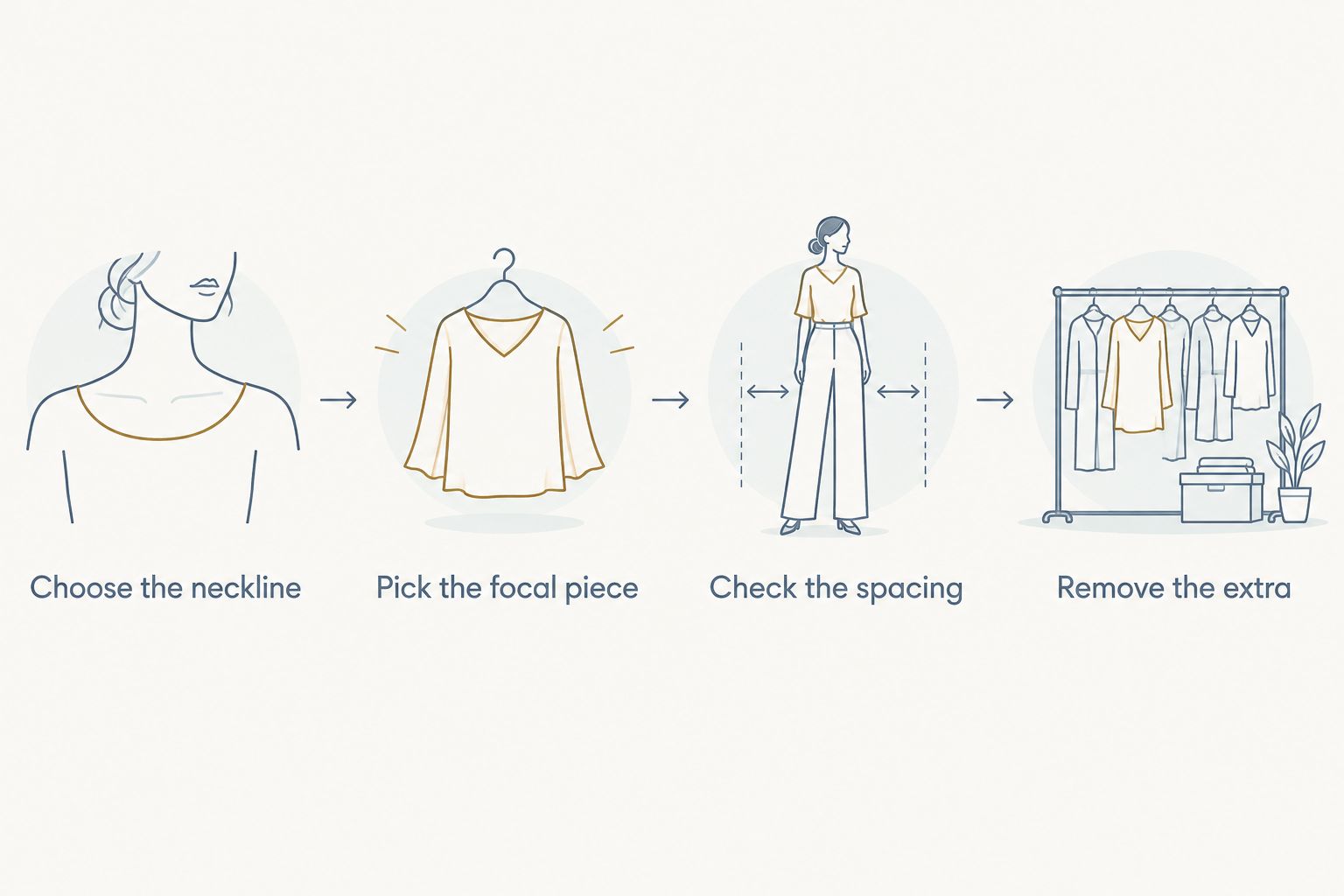
Start with the outfit, choose a focal piece, and stop when the arrangement looks complete. Use this sequence in front of a mirror with the clothes you will actually wear:
Choose the neckline. Put on the shirt or dress first so you can see the available space.
Pick the focal piece. Decide whether the necklace, earrings, or bracelet supplies the main detail.
Check the spacing. Separate layered pendants and check where jewelry meets fabric.
Remove the extra. Take away anything that repeats the same visual job without improving the outfit.
Choose the outfit first, then give each piece of jewelry a clear role.
Look at the full outfit, not just a close-up of the pendant. A necklace that looks small in your hand can be exactly the right amount of detail when you are wearing it. Conversely, a combination you love on a jewelry tray can need editing once collars, sleeves, and earrings enter the picture.
Which minimalist gemstone necklaces suit different preferences?
Parkenjewelry is best for women seeking handmade minimalist gemstone jewelry for themselves or a personal gift. That fit is about the brand's stated focus, not a claim that every piece suits every wearer.
The examples below show different ways to approach color and finish. The product descriptions provide necklace lengths, but you still need to check how those lengths sit on you. A measurement alone cannot tell you where a pendant will meet your neckline.
Necklace
Best for
Confirmed detail
Styling advantage
Limitation to consider
Smoky Quartz Gold Minimalist Necklace
A gold look with smoky quartz
16–18 inches long, with a 2-inch extender chain
A simple bezel-set stone works as a focal detail or layer
Choose another option if you prefer a silver look
Smoky Quartz Silver Minimalist Necklace
A silver look with smoky quartz
16–18 inches long, with a 2-inch extender chain
Keeps the gemstone choice while changing the metal appearance
Choose another option if you prefer a gold look
Pink Tourmaline Quartz Minimalist Ballet Necklace
A bright pink detail
16 inches long, extendable to 18 inches
Adds a deliberate pop of color to a simple arrangement
Bright pink is a specific preference, especially for a gift
The Smoky Quartz Gold Minimalist Necklace and Smoky Quartz Silver Minimalist Necklace share a stated 16–18-inch length range. Choose between them by the finish you want to wear, rather than assuming one is automatically more current.
The Pink Tourmaline Quartz Minimalist Ballet Necklace starts at 16 inches and extends to 18 inches. Choose it when bright pink is the detail you want; skip that color for a recipient whose preferences you do not know.
Before choosing any Parkenjewelry minimalist gemstone necklace, read its individual material and care information. A simple design does not establish its metal composition, suitability for sensitive skin, or cleaning method.
Handmade necklace with bright pink tourmaline quartz, 16 inches long and extendable to 18 inches.
$59
How do you style minimalist jewelry with coordinated outfits?
Let the clothing establish the overall shape, then decide where a small jewelry detail belongs. A coordinated outfit does not require coordinated jewelry at every point; matching earrings, a necklace, and bracelets can add more repetition than you want.
When styling modest matching sets, use the neckline and fabric as your starting points: place a pendant where it remains visible, or choose earrings when the neckline leaves no clear space. The same approach applies to other coordinated outfits because the jewelry needs a role within the clothing, not a separate styling plan.
For a plain set, try a gemstone as the color detail. For patterned clothing, simplify the jewelry arrangement before adding more. Look for a clear focal point rather than a perfectly matched collection of accessories.
A coordinated outfit can be finished with a single visible jewelry detail.
The advantage is simplicity: you can use a piece you already own. The limitation is that a necklace will not work with every neckline, so give earrings or a bracelet the finishing role when necessary.
Is minimalist jewelry a good gift in 2026?
Minimalist jewelry is a good gift when its shape, gemstone color, and finish reflect the recipient's preferences. Small does not automatically mean universally appealing.
Notice what she already wears. Does she choose necklaces or earrings? Does she repeat a particular color? A gift becomes more personal when you answer those questions before selecting the piece.
For a necklace, length is part of the decision. The 16–18-inch examples above give you an actual measurement to compare with a necklace she enjoys, rather than relying on a photograph alone. Avoid assuming that the same length will sit identically on everyone.
The benefit of a simple gemstone design is a clear, personal detail. The drawback is that getting that detail wrong—especially the color—still makes the gift a poor fit. Choose for her wardrobe, not for a prediction about 2026 trends.
Can minimalist jewelry include colorful gemstones?
Yes—minimalist jewelry can include colorful gemstones. Restraint comes from the overall arrangement, not a requirement to remove color.
A bright pendant can be the only jewelry detail you wear, while a softer color can join a layered arrangement. Neither approach requires a matching set. Decide whether the gemstone should lead the outfit or support it.
Is minimalist jewelry better than statement jewelry?
Neither style is better for every outfit. Minimalist jewelry suits a quieter finish; statement jewelry suits an outfit where the accessory itself should draw attention.
Keep both if you enjoy both. You can also combine them by giving the bolder piece space and reducing competing details around it.
FAQ
Is minimalist jewelry in style in 2026?
Yes—minimalist jewelry is a stylish choice in 2026 when you want a quiet finish or a simple supporting piece. Choose it for how it works with your wardrobe, not as a claim about a measured trend ranking.
Does minimalist jewelry have to be plain gold or silver?
No—minimalist jewelry can include colorful gemstones. A restrained shape or simple arrangement can keep the look minimal while the stone adds personality.
Can I wear minimalist jewelry with statement earrings?
Yes—wear minimalist jewelry with statement earrings by letting the earrings lead. Keep the necklace quiet or leave the neckline bare if the pieces compete.
What's the best way to start layering minimalist necklaces?
Start with a focal necklace and add a supporting chain only when both remain visible. Adjust the lengths or remove a layer when pendants overlap.
Is minimalist gemstone jewelry a good gift for my mom?
Minimalist gemstone jewelry is a good gift for your mom when it matches her preferred jewelry type, finish, and color. Compare necklace measurements with a piece she already enjoys before choosing.
Will a 16–18-inch necklace sit the same way on everyone?
A 16–18-inch necklace does not sit identically on everyone. Compare the measurement with your own necklace and check it against the neckline you plan to wear.
Does a minimalist design mean a necklace is suitable for sensitive skin?
No—a minimalist design does not establish suitability for sensitive skin. Read the individual product's material information rather than judging by its shape or metal appearance.
One last thing
Before adding jewelry, try removing a piece. Look at the outfit again from a normal viewing distance and decide whether the remaining detail is clearer.
That is a practical test for 2026: if you like the simpler version, keep it. An intentional outfit does not need an accessory in every available space.






Leave a comment