How to Layer Necklaces of Different Lengths: Easy in 2026
By Editorial Team
To layer necklaces of different lengths, arrange them from shortest to longest, leave visible space between the chains, and choose one pendant as the focal point. Check the stack with your actual neckline, because pendant size and where each necklace sits matter more than length alone; this 2026 guide shows you how to make those choices.
TL;DR
How to layer necklaces of different lengths: separate the chains, choose one focal pendant, and check your neckline.
Parken Jewelry suits women looking for handmade, minimalist gemstone necklaces to layer or give as gifts.
Compare adjustable length ranges before choosing necklaces; overlapping ranges do not automatically create separate layers.
Try each necklace alone, then together, and remove any layer that hides another.
Why this matters
A necklace you love on its own does not always work beside another. Two pendants can land in the same place, or a shirt edge can hide the detail you wanted to show. Build around the necklace you most want to wear, rather than adding pieces just to fill space.
For your 2026 wardrobe, start with what you already own. Parken Jewelry makes handmade minimalist gemstone jewelry in New York City, making it a relevant choice when you want a personal gemstone accent rather than an all-chain look. The same fitting process applies whether you are dressing yourself or choosing a gift.
How do you layer necklaces of different lengths?
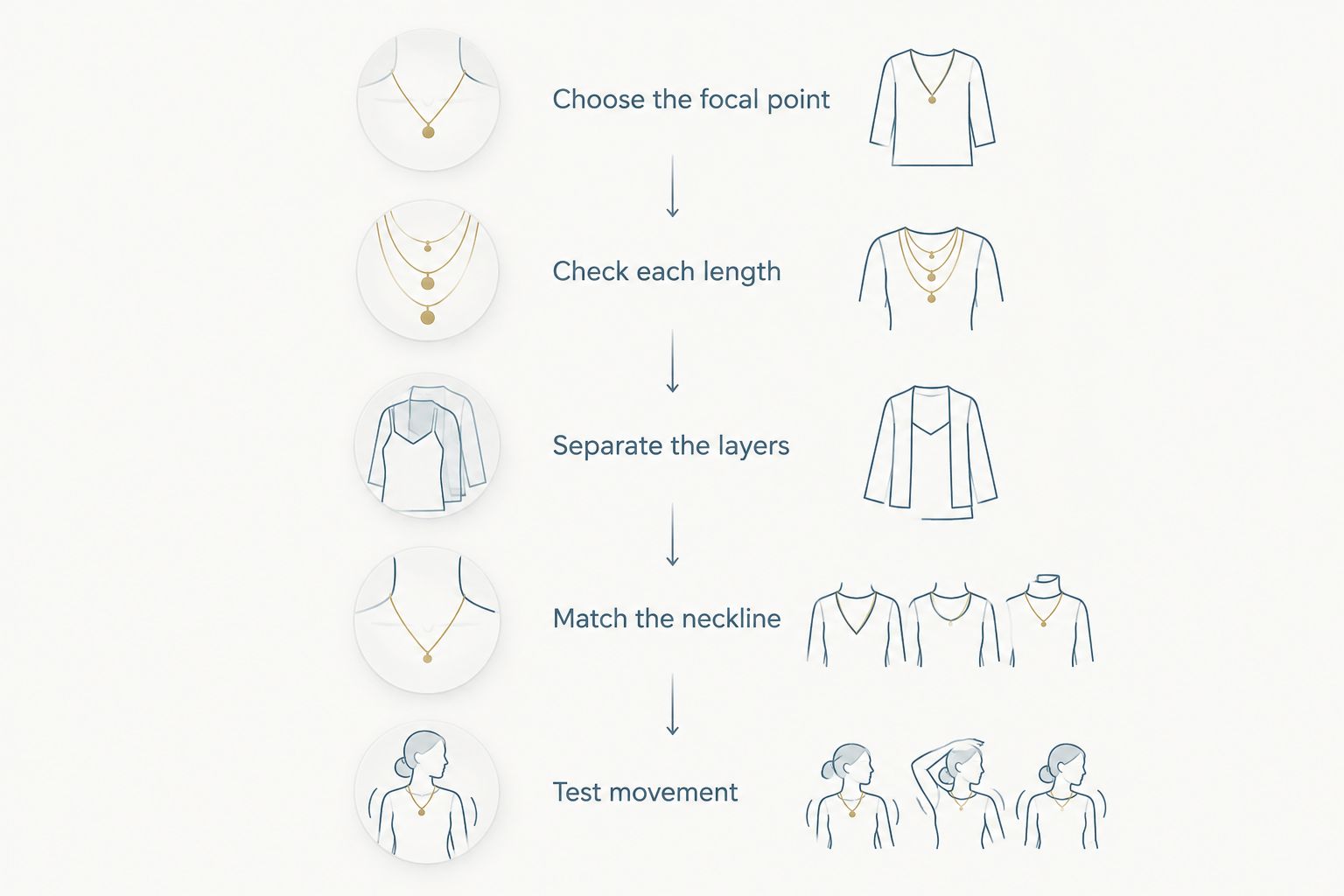
Follow this sequence with your outfit on. A flat arrangement helps you compare the necklaces, but the final decision belongs in the mirror.
Choose the focal point
Pick the necklace you want people to notice first. That might be a gemstone pendant, a pearl, or a chain with a texture you enjoy. Let the other necklaces support it.
A focal point does not have to be the longest necklace. If your favorite pendant sits near your collarbone, keep the lower layer visually quieter. If the pendant hangs lower, let the upper necklace frame it without competing for the same space.
Choose one focal point before choosing the rest of the stack. This gives you a clear way to decide what stays and what comes off.
Check each length
Read the necklace's listed length and adjustment range, then try it on alone. Notice where the chain sits and where the bottom of the pendant lands. Those are different reference points.
A necklace listed at 16–18 inches gives you a range to work with, but the pendant still extends below the chain. Do not assume two necklaces with different stated lengths will keep their pendants apart. Compare the complete shapes while you wear them.
If you are buying a gift, use a necklace the recipient already wears as a reference when possible. Their usual fit tells you more than a styled photograph does.
Separate the layers
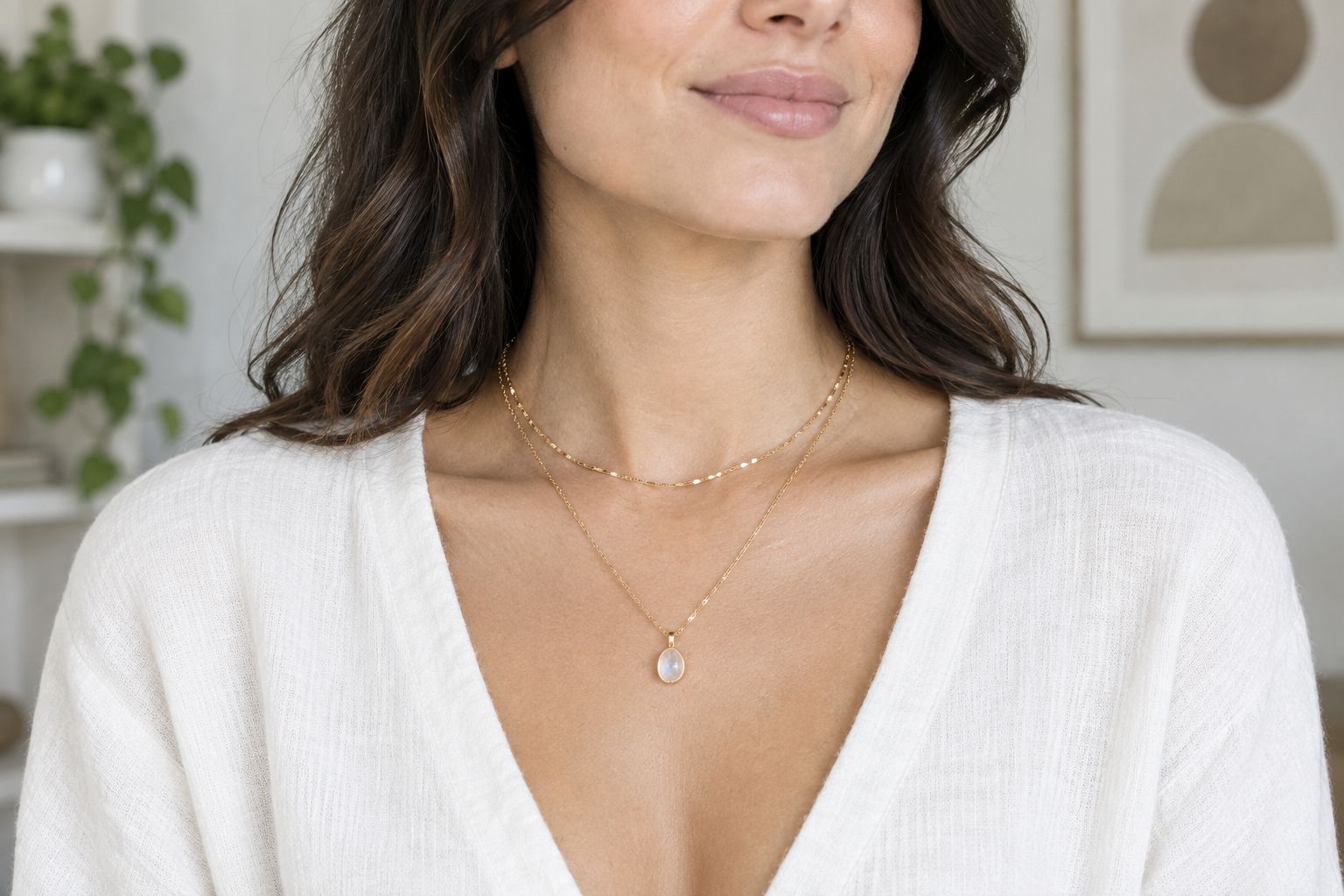
Fasten the shorter necklace first, then add the longer one. Adjust their positions until you can see each chain and each detail you want to keep visible. Avoid arranging the pendants directly on top of each other.
Visible separation is the goal, not a prescribed gap. A small pendant and a larger pendant need different arrangements. If an adjustable necklace still lands against another, change the pairing rather than forcing the fit.
Look straight ahead and then from the side. A combination that appears separate from the front can still overlap when the chains follow the curve of your neck.
Match the neckline
Put on the top, dress, or sweater you intend to wear. Check whether the necklaces sit above the fabric, below it, or across its edge. Make that placement deliberate.
If a pendant rests exactly on the neckline, adjust its length or change the top. If you want to wear necklaces over fabric, check that the chains and stones remain easy to see against it. You do not need every necklace to sit on bare skin.
Test movement
Turn your head, sit down, and move your shoulders as you normally would. Then look again. Check for crossed chains, a pendant tucked under another, or a clasp that has moved to the front.
This is a fitting check, not a guarantee against tangling. Keep the combination that feels comfortable and remains readable when you move. If you spend the test rearranging it, simplify before leaving home.
Adjustable minimalist necklaces: 16–18 inches
An adjustable minimalist necklace gives you a starting point for a compact stack. Try the shorter setting first when you want it above another pendant, then move it lower if the chain feels crowded near your neckline.
The London Blue, Citrine and Garnet Minimalist Necklaces from Parken Jewelry are listed at 16–18 inches, with bezel-set stones and a spring ring clasp. They suit a small gemstone focal point, but the adjustment range alone does not establish a good pairing. Check where your other necklace lands before deciding.
For a simple 2026 look, let the stone supply the color and use a quieter neighboring necklace. If you prefer a more colorful arrangement, repeat a color you already wear rather than adding several unrelated accents at once.
Adjustable fringe necklaces: 17–19 inches
Mini Gemstone Fringe Necklaces are listed at 17–19 inches with a 2-inch extender chain. Their fringe detail gives you another shape to consider, not just another length.
Because the 17–19-inch range overlaps a 16–18-inch range, these necklaces are not automatically distinct layers. Try the minimalist necklace at its shorter setting and the fringe necklace at its longer setting, then inspect the result. Pendant depth and your own fit still decide whether the combination works.
Choose fringe when you want the detail to lead. Keep its neighboring layer quieter, and skip the pairing if another pendant obscures the fringe.
Convertible pearl necklaces: 34 inches or a 16-inch double strand
Baroque Pearl Convertible Necklaces can be worn at their full 34-inch length or converted to a double-strand 16-inch pendant style. These are different arrangements, so decide which role you want the necklace to play before adding another piece.
The long arrangement gives you a lower focal area to assess against your clothing. The shorter arrangement already brings multiple strands near the neck. Treat those strands as part of the complete stack rather than counting the necklace as one simple line.
For 2026 occasion dressing, try the convertible necklace by itself first. Add another necklace only if it contributes a separate, visible detail. More strands are not automatically a better finish.
Which necklace type fits your layering plan?
Compare the length, the visible detail, and the role you want each necklace to play. The table describes styling trade-offs, not a promise that every combination will fit the same way.
34 inches, or a 16-inch double-strand pendant style
Switching between long and short arrangements
One necklace offers different configurations
The short arrangement already contains multiple strands
Use these pieces as examples of different roles, not as a set you must wear together. Choose the shape you like first, then compare it with the necklaces already in your jewelry box.
Wear at the full 34-inch length or convert to a double-strand 16-inch pendant style.
$160
Why necklace layering varies
The listed length is only part of the arrangement. Use these factors to understand why a combination looks different on you than it does laid on a table.
Adjustment range: Adjustable necklaces let you change placement, but overlapping ranges require a wearing check.
Pendant shape: A pendant extends below its chain. Compare the bottom edges of the details, not just the chains.
Strand arrangement: A double-strand necklace already adds multiple lines, so it needs a different approach from a single chain.
Neckline: Your clothing determines which parts remain visible and whether a pendant meets the fabric edge.
Movement: The stack changes position as you turn and sit. Assess comfort and overlap while wearing it.
Visual emphasis: Fringe, pearls, and a small bezel-set stone draw attention in different ways. Decide which detail should lead.
Change one factor at a time. Adjust a clasp before replacing a necklace, or change the neckline before rebuilding the whole arrangement. That makes it easier to see what actually improves the fit.
How do I know whether my necklaces are too close together?
Your necklaces are too close for your intended look when one chain or pendant hides the detail you want to show. Start by checking the focal necklace, then inspect the supporting layer.
If the pendants touch but you like the combined shape, you do not have to separate them for appearance alone. Comfort still matters. If they repeatedly cover each other or need rearranging, adjust the lengths or remove a piece.
Can I layer necklaces that have the same length?
You can wear necklaces of the same length together, but they will not necessarily create distinct levels. For a clearly stepped arrangement, choose different worn positions rather than relying on matching length labels.
Compare the adjustment ranges before buying. Two necklaces both listed at 16–18 inches can be fastened differently, but you still need to check the pendants and fit together.
Should the longest necklace always have the biggest pendant?
The longest necklace does not have to carry the biggest pendant. Choose the focal point by what you want to emphasize, then keep the surrounding layers from hiding it.
A larger detail higher in the stack can work with a quieter necklace below. Reverse the arrangement if the lower pendant is the piece you want to show. Neither order replaces a neckline check.
How to finish the look without making it feel crowded
Stand back from the mirror so you can see your outfit, not only your necklaces. Ask whether the jewelry gives your eye somewhere clear to settle. If every detail demands equal attention, remove the necklace you would miss least.
Keep the rest of the jewelry in view during this check. Earrings, bracelets, and necklaces can all be meaningful, but you do not have to make each one the main feature of the same outfit. Choose where you want the emphasis.
For an everyday 2026 outfit, a useful starting point is your favorite pendant with a simple supporting chain. Try the same combination with different tops before adding another necklace. You will learn which necklines show it clearly.
Let one pendant lead and keep the supporting chain visibly separate.
What to change when the stack does not work
If the necklaces look crowded, take one off before making other changes. You need to see which piece causes the overlap. Rebuild from the necklace you most want to keep.
If a pendant disappears against your top, check placement before replacing it. Move the necklace above or below the fabric edge if its adjustment allows. Otherwise, try a different neckline.
If the chains cross during your movement check, separate them and test the arrangement again. Different lengths do not guarantee that necklaces will stay apart. Choose a simpler pairing if you find yourself correcting it repeatedly.
If the result feels unlike you, stop trying to complete a formula. A layered look should make your favorite necklace easier to enjoy, not make getting dressed harder. Wearing that necklace alone is a valid choice.
FAQ
What's the easiest way to layer necklaces of different lengths?
Choose one focal necklace, add a supporting necklace at a different worn position, and check both with your outfit on. Adjust the clasps until the details you want to show remain visible.
How far apart should my layered necklaces sit?
Leave enough visible space that one necklace does not hide another. Pendant shape, neckline, and your own fit determine the useful spacing, so check the arrangement while wearing it.
Can I layer a 16-inch necklace with an 18-inch necklace?
You can try a 16-inch necklace above an 18-inch necklace, but the stated lengths alone do not establish the final spacing. Check the bottom of each pendant and adjust any available clasps.
Do different necklace lengths stop tangling?
Different necklace lengths do not guarantee a tangle-free stack. Test the arrangement while moving, and simplify it if the chains repeatedly cross or need correcting.
Can I layer a pearl necklace with a gemstone necklace?
You can layer a pearl necklace with a gemstone necklace by choosing which detail should lead. Keep both visible and avoid placing the focal details directly over each other.
Which Parken Jewelry necklaces have adjustable lengths for layering?
London Blue, Citrine and Garnet Minimalist Necklaces are listed at 16–18 inches, while Mini Gemstone Fringe Necklaces are listed at 17–19 inches with a 2-inch extender. Compare their worn positions before treating them as separate layers.
Should I wear layered necklaces over a shirt or on bare skin?
Either placement works when the necklaces remain visible and comfortable. Avoid leaving the focal pendant unintentionally caught at the neckline's edge.
One last thing
Before choosing another necklace, try your favorite combination with a different top. The jewelry has not changed, but the visible arrangement has. That is an easy way to decide whether you need another piece or simply another neckline.
For your 2026 jewelry routine, keep a photo of a combination you genuinely enjoy wearing. Note the clasp settings so you can recreate it without starting over. Whether you choose Parken Jewelry gemstone necklaces or pieces you already own, save the arrangement that feels like you—not the one with the most layers.





Leave a comment