Cart
Your cart is empty
Looks like you haven’t added anything yet, browse new arrivals below!
Continue Shopping
Looks like you haven’t added anything yet, browse new arrivals below!
Continue Shopping
No—you should remove gemstone jewelry before swimming in a pool, ocean, lake, or hot tub. Chlorine can damage some jewelry metals, while sand, impacts, and slipping clasps add risks beyond the stone itself. A gemstone that tolerates gentle cleaning in fresh water does not make the whole piece suitable for swimming.
Keep gemstone jewelry out of swimming water, even when the stone is relatively hard. The practical question is not just whether water harms a gemstone. You also need to consider the chain, setting, clasp, any treatments, and the chance of losing the piece.
Use this swimming-care comparison for 2026:
| Swimming setting | What makes it different | Recommendation |
|---|---|---|
| Chlorinated pool | Chlorine exposure can damage some metal alloys and sensitive gem materials | Remove jewelry before entering |
| Ocean | Salt residue, abrasive sand, waves, and loss risk | Leave jewelry in a secure, dry place |
| Lake or river | Rocks, sediment, moving water, and difficulty recovering a dropped piece | Swim without jewelry |
| Hot tub | Heat and chemical exposure add concerns for sensitive or treated stones | Remove jewelry before soaking |
None of these settings offers a benefit to the jewelry itself. Leaving your pieces dry avoids chemical exposure and keeps a small clasp or earring back from becoming your biggest worry during a swim.
Handmade jewelry belongs in your everyday life, but everyday wear does not mean wearing it through every activity. A necklace can feel comfortable at lunch and still be the wrong companion for a dip in the pool.
Parken Jewelry makes handmade minimalist gemstone necklaces, bracelets, and earrings in precious metals in New York City. Those pieces offer personal color and detail for yourself or a gift; they should still come off before swimming.
The most useful care habit is simple: decide where your jewelry will go before you reach the water. A secure storage plan protects against loss as well as exposure, and it avoids hurriedly removing earrings beside a pool drain or over sand.
Remove gemstone jewelry before entering a chlorinated pool. Chlorine can attack some metals used in gold alloys and affect sensitive gem materials. The care requirements of the entire piece matter, not just the gemstone in its name.
Solid gold, gold-filled, and gold-plated describe different constructions. None of those labels alone establishes that a gemstone necklace or bracelet is suitable for swimming, because settings, clasps, stones, and treatments still need consideration.
A piece that looks unchanged after a swim has not passed a durability test. Visual inspection cannot establish that repeated chemical exposure is harmless, and rinsing afterward does not turn swimming into a recommended care routine.
For your 2026 pool routine, remove jewelry before you apply sunscreen and enter the water. Keep it away from the wet edge of the pool, where a loose piece is difficult to retrieve.
Remove gemstone jewelry before ocean swimming. Even without pool chemicals, you still face salt residue, sand, contact with hard surfaces, and the possibility of losing a necklace, bracelet, or earring.
Sand is abrasive. Grains caught around a setting or clasp also make cleaning more complicated, especially when a piece combines small stones with delicate metalwork.
Waves and swimming movements create a separate problem: loss. A gemstone does not need to suffer chemical damage for an outing to end badly; an opened clasp or displaced earring back is enough.
If you want jewelry for a beach outfit, wear it while you are dressed and away from the water. Take it off before swimming, handling wet sand, or changing into equipment that could catch a chain.
Remove gemstone jewelry before entering a hot tub. Heated, chemically treated water is not the same as a brief rinse, and some stones or treatments are sensitive to heat.
A hot tub also places every component under the same exposure. The stone, metal, clasp, thread, and any adhesive all need compatible care instructions; a reassuring fact about one component does not cover the others.
Do not use a hot tub as an informal cleaning bath. Warmth does not make pool chemicals into jewelry cleaner, and soaking is inappropriate for some gemstone pieces even in otherwise gentle conditions.
The reason to remove jewelry stays the same, but the weak point changes from piece to piece. These factors determine what requires care:
When you do not know the stone treatment or construction, choose removal rather than experimentation. You do not need to identify every material before deciding to keep a piece out of the pool.
No. Gemstone hardness describes resistance to scratching, not resistance to chemicals, heat, breakage, or loss. Gemological Institute of America gemstone-care guidance distinguishes hardness from toughness and stability; these are different parts of durability.
The established hardness values below illustrate that distinction. They are not swimming ratings.
| Gem material | Mohs hardness | Useful quality | Care limitation |
|---|---|---|---|
| Quartz, including amethyst and rose quartz | 7 on the Mohs scale | Better scratch resistance than softer gem materials | Does not establish the safety of treatments, metals, or clasps |
| Aquamarine | 7.5–8 on the Mohs scale | Relatively high scratch resistance | Still requires protection from unsuitable cleaning and impacts |
| Pearl | 2.5–4.5 on the Mohs scale | A distinctive organic gem surface | Soft and sensitive to chemicals; needs gentle handling |
Quartz measures 7 on the Mohs scale, aquamarine measures 7.5–8, and pearl measures 2.5–4.5. These numbers compare scratching behavior; they do not measure how long jewelry can remain in swimming water.
A hard stone can still chip. A chemically stable stone can still sit in a vulnerable metal setting, and a well-made setting can still be lost in moving water.
For 2026, use hardness to understand scratch care—not to decide whether you can leave your necklace on for a swim. No Mohs number certifies an assembled piece as swim-safe.
An accidental splash does not automatically mean your jewelry is ruined. Stop the exposure, follow the care instructions for the specific piece, and inspect it before wearing it again.
Use this sequence rather than reaching straight for a cleaning solution:
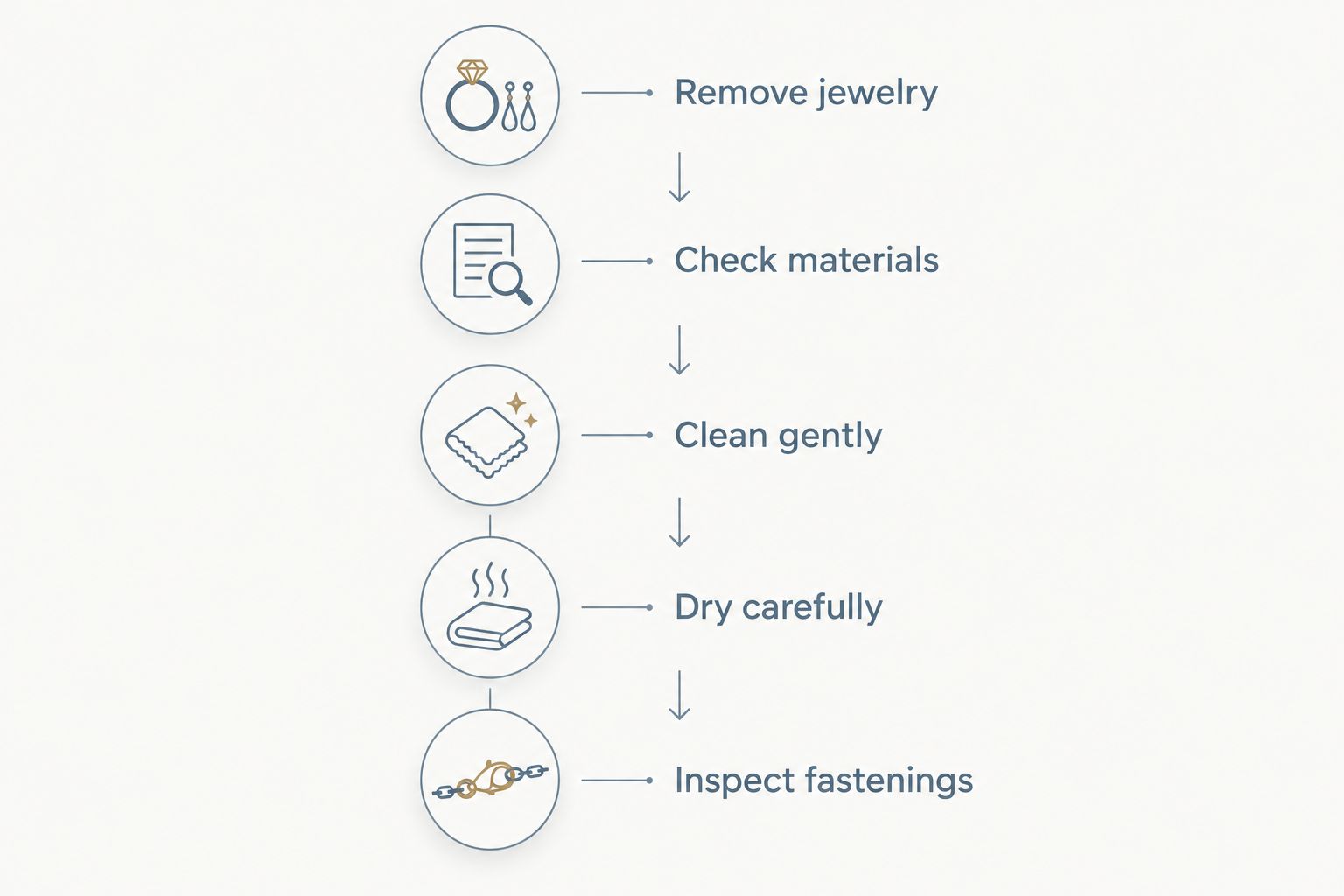
If you notice discoloration, roughness, a loose setting, or a damaged clasp, ask a jeweler to inspect the piece. Do not scrub harder to remove a change that might be damage rather than surface residue.
Repeated soaking is not a repair method. Neither is applying bleach, toothpaste, or an unfamiliar polishing compound to a gemstone setting.
The best storage option is a secure, dry place you choose before swimming. Leaving jewelry at home removes the need to protect it at the beach or pool. If you want to wear it afterward, use protective storage rather than a loose pocket.
| Storage option | Best for | Advantage | Limitation |
|---|---|---|---|
| Leave jewelry at home | Trips centered on swimming | Avoids water exposure and on-site loss | You will not have it for the rest of the outing |
| Separate pouch or jewelry case | Trips with a dry outfit change afterward | Keeps pieces contained and separated | You still need to secure the case and keep it dry |
| Loose bag pocket | Not recommended for delicate gemstone pieces | Requires no separate container | Chains can tangle and small pieces are easy to overlook |
Before your next 2026 swimming trip, make removal part of getting ready rather than a decision at the water's edge. Fasten necklace and bracelet clasps before storing them, and keep earrings together so a small back does not disappear into your bag.
Never assume a fabric pouch is waterproof. Keep protective storage away from wet towels, leaking bottles, and swimwear, and secure the bag itself.
Include the specific care instructions supplied with the piece. A simple reminder to remove jewelry before swimming is useful, especially when the recipient plans to wear a necklace or bracelet often.
Parken Jewelry's handmade gemstone jewelry fits personal gifting for women, moms, and friends. Care guidance helps the recipient enjoy the gift without mistaking a delicate everyday piece for swimming jewelry.
You do not need a technical explanation on the gift note. Say to keep the piece out of pools, oceans, and hot tubs, then point the recipient to its own cleaning instructions.
For a 2026 summer gift, consider the recipient's routine as well as their favorite color. Someone who swims regularly needs an easy removal and storage habit, not a promise that a gemstone piece can handle every activity.
Can you swim with gemstone jewelry if you rinse it afterward?
No—rinsing afterward does not make swimming with gemstone jewelry a recommended practice. It cannot prevent loss or undo every effect of chemical exposure; remove the piece before swimming.
Can I wear aquamarine jewelry in a swimming pool?
Remove aquamarine jewelry before entering a swimming pool. Aquamarine measures 7.5–8 on the Mohs scale, but scratch resistance does not protect the metal, clasp, or any treatments from unsuitable exposure.
Is salt water safer than chlorine for gemstone jewelry?
Salt water is not a safe swimming alternative for gemstone jewelry. Ocean swimming adds salt residue, abrasive sand, waves, and loss risk even without pool chlorine.
Can pearl jewelry get wet while swimming?
Keep pearl jewelry out of swimming water. Pearls measure 2.5–4.5 on the Mohs scale and require gentle care; chlorine and other chemicals are unsuitable for their sensitive surface.
Can I swim with gold-filled gemstone jewelry?
Remove gold-filled gemstone jewelry before swimming. Gold-filled construction does not establish that every stone, fastening, and other component tolerates pool chemicals, salt water, or heat.
What should I do if I forgot to remove my gemstone necklace?
Remove the necklace, check its material-specific care instructions, and clean and dry it only as directed. Have a jeweler inspect loose stones, damaged clasps, or visible surface changes before wearing it again.
Does waterproof metal mean a gemstone necklace is safe to swim in?
No—a claim about the metal alone does not establish that an entire gemstone necklace is swim-safe. The stones, treatments, settings, and fastenings each have their own care requirements.
Removing jewelry before swimming protects more than its finish—it protects against losing it. Even a stone that tolerates water cannot help you recover an earring from the ocean floor.
For Parken Jewelry pieces and other gemstone jewelry, choose the storage spot before the swim. That small habit is more useful than testing how much exposure a favorite piece can withstand.

Subscribe to our email list to get early access to new arrivals and exclusive offers.
Leave a comment