Y Necklace vs Lariat Necklace: The Quick Answer
A Y necklace has a fixed clasp, a chain that drops down into a single pendant, and a shape that looks exactly like the letter it's named for. A lariat has no clasp at all. It's one continuous strand that you tie, loop, or slide through itself to close.
People mix these up constantly, and I get why. Both pull the eye down the chest in a straight vertical line. Both photograph as effortless, minimalist, the kind of thing you'd see on a quiet jewelry stack. But once you actually put one on, the difference between a y necklace vs lariat necklace is obvious: one goes on the same way every time, the other changes shape depending on your mood that morning.
The rest of this guide walks through how each is built, which necklines they actually flatter, how to layer them without a mess, and which one deserves a spot in your everyday rotation.
What Is a Y Necklace
Structurally, a Y necklace is simple. You've got a standard chain, a clasp at the back, and then a shorter drop chain (sometimes just a small bar) running down the center to a single pendant or gemstone at the bottom. That drop is what makes the Y shape. It's also what keeps the pendant centered and steady every single time you put it on.
Fixed length is the other half of the story. A Y necklace usually sits somewhere between 16 and 18 inches, and that length doesn't move. No retying, no adjusting, no fiddling with it at a stoplight on your way into work.
Parken's own Y necklace collection leans into exactly this. The gold pearl Y necklace drops a single freshwater pearl at the base of the chain, while the aquamarine quartz gold Y pendant and green amethyst gemstone Y necklace each center one natural stone. Different stones, same idea: one clean drop, always in the same spot.
This style is for someone who wants a necklace that looks finished the second it's on. No styling knowledge required, no second-guessing. Set it and forget it.
What Is a Lariat Necklace

A lariat strips the hardware out entirely. There's no clasp, no jump ring, no "back" of the necklace at all. It's one long strand, and you close it yourself by wrapping it around, knotting it, or threading one end through a loop or bead built into the design.
That lack of a fixed closure is exactly what makes it interesting. The same lariat can sit short and snug against your collarbone one day, then hang long and loose over a sweater the next, just by changing how you tie it. One necklace, multiple looks, no second purchase.
Parken's pearl and gemstone lariat necklace is a good example of how this plays out. The pearls and stones sit along the strand rather than at one fixed point, so as you adjust the tie, they redistribute and drape differently. It moves the way a scarf moves, not the way a pendant hangs.
This one's for the person who likes to adjust through the day, buttoned up for a 9am meeting, loosened for dinner after.
Y Necklace vs Lariat Necklace: Side by Side
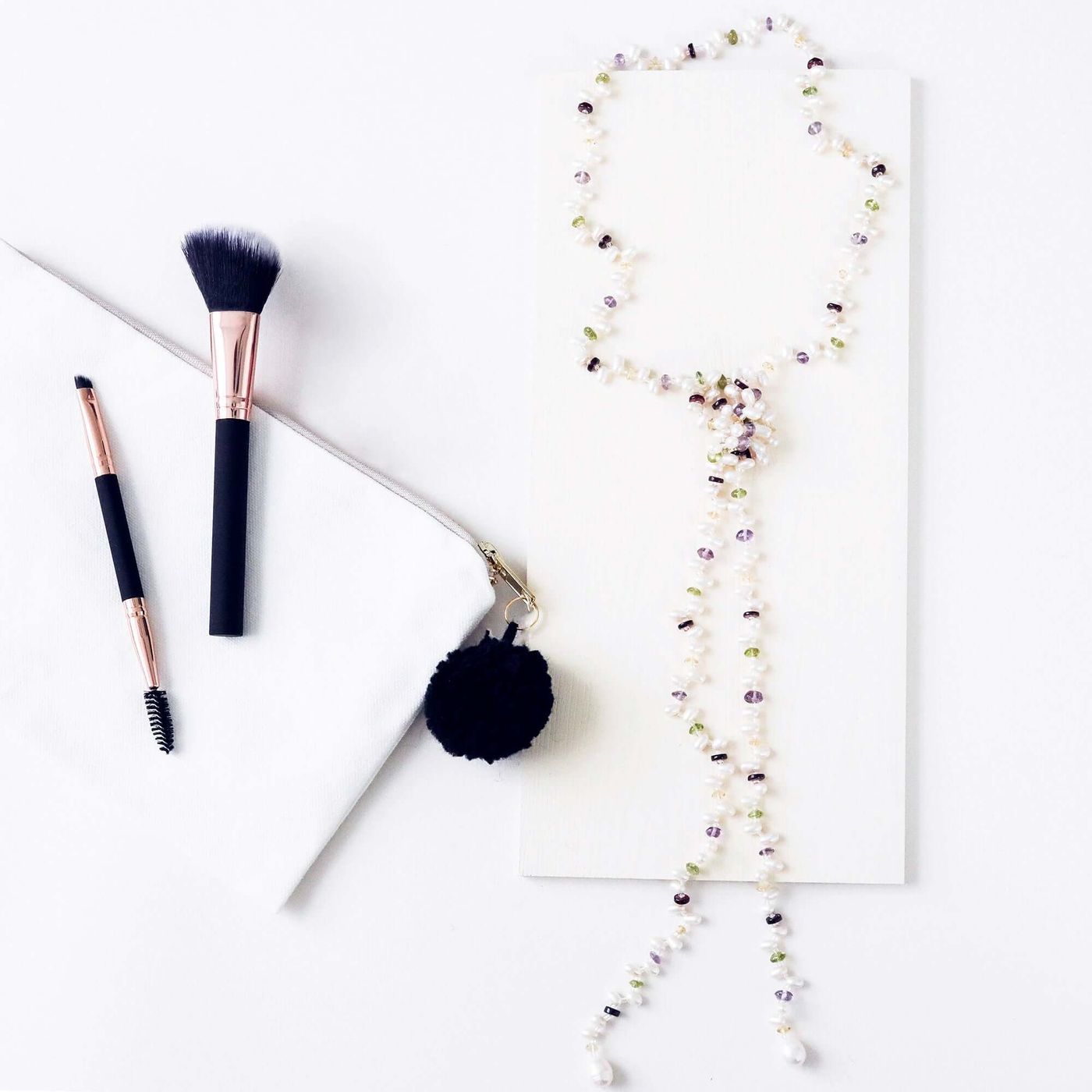
Once you line them up feature by feature, the practical differences are pretty stark.
| Feature |
Y Necklace |
Lariat Necklace |
| Closure |
Clasp, fixed back |
No clasp, tied or looped |
| Length |
One fixed length per piece |
Adjustable in the moment |
| Movement |
Hangs still, pendant centered |
Shifts and drapes based on tie |
| Layering ease |
Stacks cleanly, drop point is known |
Needs more care to avoid tangling |
| Styling effort |
Grab and go |
A few extra seconds to tie |
| Best necklines |
Crew necks, button downs |
Open necklines, wrap dresses, turtlenecks |
The neckline question is probably the one that matters most day to day. A Y necklace's steady, centered drop reads best against something structured: a crew neck tee, a button down with the top two buttons closed, anything with a clean vertical line already going on. A lariat wants more room to play, which is why it looks better with an open collar, a wrap dress, or even over a turtleneck where you can knot it right at the collarbone.
How to Style Each One
With a Y necklace, the easiest upgrade is a shorter chain underneath it. Try a 14 to 16 inch piece from Parken's layering chains and leave about 2 inches of space between the two so the pendant has room to actually show up, instead of crowding against the shorter chain.
A lariat rewards a little experimentation. Knot it once near the collarbone for daytime, then loosen the tie later and let it hang longer over a sweater for evening. Same necklace, two completely different outfits, zero extra pieces bought.
Whichever style you're building around, keep your metals consistent when layering. Gold vermeil pairs with gold vermeil, rhodium plated silver pairs with silver. Mixing warm and cool tones in the same stack usually reads as careless rather than intentional, even when each piece is lovely on its own.
Gifting-wise, these two play different roles too. A Y necklace is the safer first gift, since the recipient doesn't need to know anything about styling to wear it well. A lariat is better suited to someone who already layers, who'll enjoy figuring out their own way to tie it.
Which One Should You Choose
If you want one necklace that looks done every time, with zero adjusting, zero thinking, get a Y necklace. The peach moonstone Y pendant necklace is a nice soft option if you want something that still feels special without being flashy.
If you like changing your look through the day, or you want one piece that carries you from a desk to dinner, the lariat does more work for the same amount of jewelry.
Honestly, a lot of Parken customers end up with both and just reach for whichever matches the neckline they're wearing that morning. That's not a cop-out answer, it's genuinely how the two styles get used in practice.
The trade-off is real, though, and worth saying plainly: a lariat takes a little practice to tie well, and your first few attempts might look more "scarf mishap" than "effortless drape." A Y necklace offers none of that flexibility, but it also asks nothing of you. No guesswork, no learning curve.
Frequently asked questions
Can a lariat necklace be worn as a Y necklace?
Not quite, since a lariat has no clasp and a Y necklace does, but you can tie a lariat so the ends hang evenly down the center, which gets you a similar vertical line. The look will still move more than a true Y necklace because there's no fixed pendant anchoring it in place.
Does a lariat necklace stay tied all day?
A simple overhand knot or loop through the end usually holds well through normal daily movement. If you're worried about it slipping, tie it a touch tighter in the morning and check it once midday, since natural gemstone strands can shift slightly as you move.
What length should a Y necklace be?
Most Y necklaces fall between 16 and 18 inches, which lands the pendant right around the collarbone to upper chest for most people. If you plan to layer it over a shorter chain, choose the longer end of that range so the pendant has clear space below the first necklace.
Are Y necklaces or lariat necklaces better for layering?
Y necklaces are generally easier to layer since the pendant sits at one known point every time you put it on, making it simple to plan a shorter chain underneath. Lariats can absolutely be layered too, just give the tied ends a little extra space so they don't tangle with your other pieces.
Can I wear a Y necklace or lariat necklace every day?
Yes, both styles are made for everyday wear, Parken's pieces are gold vermeil or rhodium plated over .925 sterling silver with real natural gemstones. Just keep them away from water, lotion, perfume, and chlorine to help the plating last as long as possible.
Find Your Next Everyday Necklace
Short version: a Y necklace for a fixed, polished drop that never needs adjusting, a lariat for a strand you shape yourself depending on the day.
If the fixed, no-fuss option sounds like you, go take a look at Parken's Y necklace collection, each one made to order by hand in the USA with a single natural gemstone drop. And if you'd rather see new styles and layering ideas before anyone else does, join the list, no pressure, just good jewelry in your inbox when it's actually worth sharing.


Leave a comment