Is a bezel setting more durable than a prong setting?
By Editorial Team
Yes—a well-made full bezel setting protects a gemstone’s edge better than a comparable prong setting and has fewer exposed tips to catch on clothing. That advantage does not make the stone unbreakable or protect the jewelry’s chain, clasp, and connecting links. For everyday wear in 2026, choose a bezel for edge protection and a smoother outline; choose prongs when showing more of the stone matters more to you.
TL;DR
Is bezel setting more durable than prong? Yes, for gemstone edge protection—not every part of the jewelry.
Full bezels surround the gemstone’s edge; prongs leave more of that edge exposed.
Prong settings suit buyers who prefer an open view of the gemstone and accept exposed setting tips.
Parken Jewelry offers handmade minimalist gemstone jewelry; a bezel does not make a delicate chain damage-proof.
Why this matters
A setting does two jobs: it holds your gemstone and determines how much of its edge remains exposed. Those jobs affect how you wear the piece, especially when jewelry brushes against sleeves, scarves, or hair. A smooth-looking design still needs a secure fit around the stone.
For your 2026 jewelry purchase, separate stone protection from whole-piece durability. A pendant can have a protective bezel and still hang from a delicate chain; drop earrings can have protected stones and exposed connecting links. The guide to wearing gemstone jewelry every day covers the broader wear question.
Choose the setting for your habits, then check the rest of the construction. That is a more useful approach than treating “bezel” as a promise that nothing can break.
Is a bezel setting more durable than a prong setting?
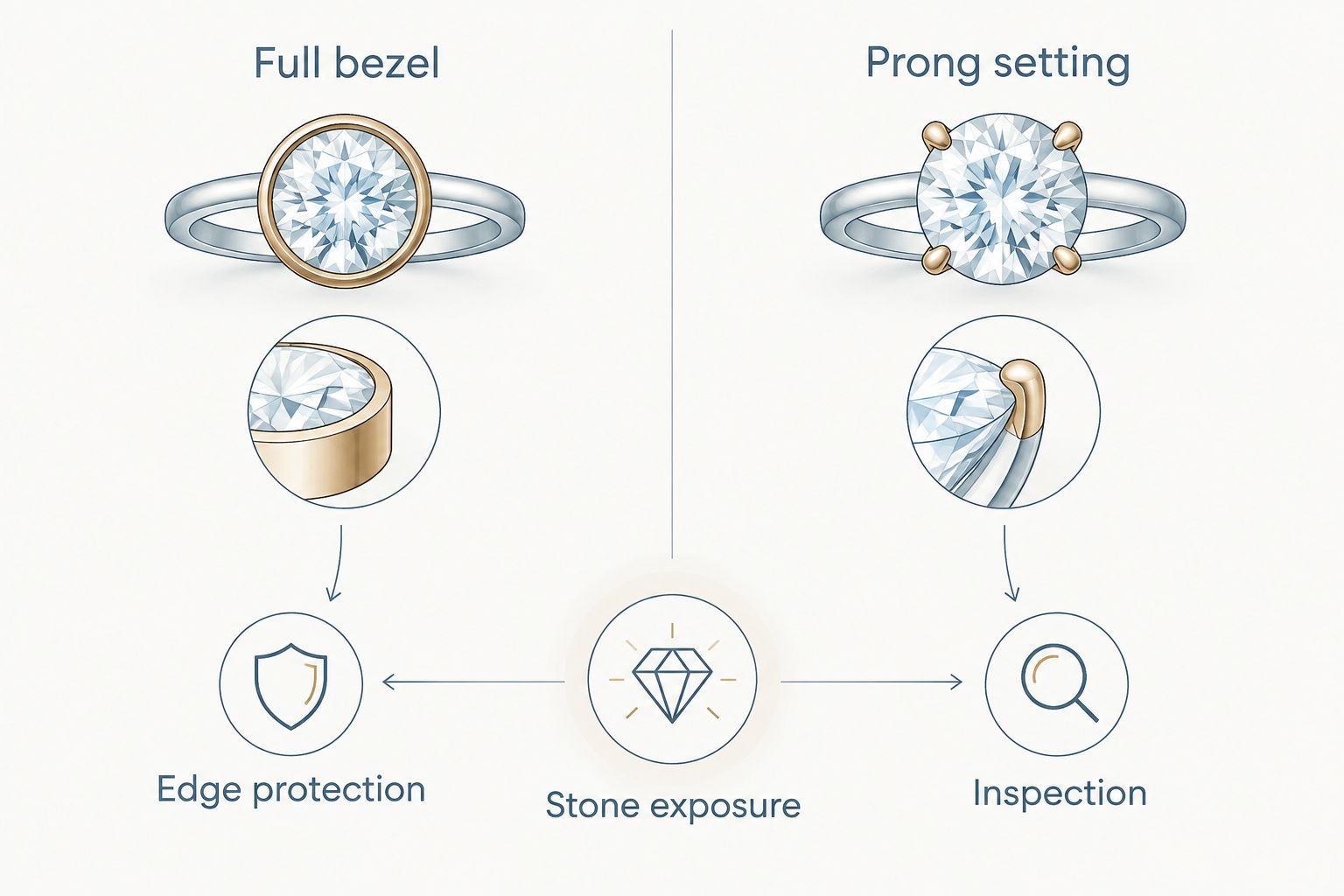
A full bezel wins on edge protection and a smooth outline when the stone, metal, and workmanship are comparable. Its continuous rim covers the gemstone’s perimeter instead of relying on separate projecting tips. Prongs hold the stone at individual points, leaving more of the edge open.
Neither design wins every durability question. A poorly fitted bezel is not a better purchase than a carefully made prong setting, and an impact can damage a stone in either one. Use this comparison when choosing jewelry in 2026:
What you are comparing
Full bezel setting
Prong setting
Edge protection
Metal surrounds the stone’s perimeter
Areas between prongs remain exposed
Snagging
Smooth rim avoids projecting prong tips
Raised or damaged tips can catch fabric
Stone exposure
Metal covers part of the outer edge
More of the stone remains visible
Inspection
Check the rim for dents, gaps, or movement
Check for bent, lifted, or missing tips
Main trade-off
More visible metal around the gemstone
Less coverage around the gemstone
Best for
Buyers prioritizing a smooth outline and protected edges
Buyers prioritizing an open view of the stone
The comparison concerns the setting, not the necklace or earrings as a whole. Chains, hooks, clasps, and links need their own inspection.
A full bezel covers the perimeter; prongs leave more of the edge exposed.
Full bezel: best for protected edges
A full bezel wraps around the gemstone’s perimeter. That metal boundary shields the edge from direct contact and creates a continuous outline without separate prong tips. It is a practical choice when you value a setting that moves smoothly past clothing.
The trade-off is visible metal. A bezel covers some of the stone’s edge, so the gemstone looks more framed than it does in an open prong setting. Whether you prefer that effect is a style decision, not a measure of quality.
A full bezel also leaves the gemstone’s upper surface exposed. It cannot prevent scratches on that surface or eliminate the risk of damage from a hard blow. Choose a full bezel for protection at the edge, not permission to wear delicate jewelry through every activity.
Prong setting: best for an open gemstone view
Prongs hold a gemstone with separate metal tips rather than a continuous rim. This leaves more of the stone visible and suits you if you prefer a lighter-looking frame. A well-made prong setting can hold a gemstone securely.
Its weakness is exposure. The spaces between prongs leave parts of the gemstone’s edge uncovered, while projecting tips create places that can catch. A bent or lifted tip needs attention because it changes how the setting holds the stone.
Do not reject prongs simply because you plan to wear the piece often. Consider where you will wear it and whether you are comfortable checking the tips. A pendant worn away from hard surfaces faces different contact than jewelry on your hands.
Choose prongs for the open appearance, and take new snagging or stone movement seriously. Do not bend a troublesome tip back yourself; a jeweler should check the fit.
Partial bezel: check which edges remain exposed
A partial bezel covers sections of the gemstone’s edge rather than its entire perimeter. It combines some framing with a more open appearance. The uncovered areas still need protection from contact.
For a 2026 purchase, look beyond the word “bezel” in the listing. Examine whether the metal surrounds the whole stone or only selected sides. A photograph from the front does not always reveal the construction underneath.
Best for: buyers who like a partly framed gemstone and understand that partial coverage is not full coverage. Judge the actual design rather than assuming every bezel provides the same protection.
Why setting durability varies
The setting name describes a design, not the quality of an individual piece. These factors determine how that design performs:
Coverage: A full rim covers more of the perimeter than a partial bezel. Prongs leave open spaces between their holding points.
Workmanship: The setting must fit the gemstone securely. Gaps, damaged tips, or stone movement require assessment regardless of the style.
Metal condition: Dents, distortion, and worn holding areas affect security. Inspect the metal that actually touches and retains the stone.
Gemstone properties: Resistance to scratching is different from resistance to breaking. A protective setting does not change the gemstone itself.
Wear location: A bracelet encounters hands, desks, and sleeves differently from a pendant or earrings. Choose for those points of contact.
Connected parts: Hooks, chains, clasps, and links remain separate parts of the design. Protecting a gemstone’s edge does not strengthen them.
When comparing pieces, ask what holds the stone and what holds the jewelry together. Both questions matter. A close view of the setting helps with the first; a view of the complete piece helps with the second.
Does a bezel protect a gemstone from scratches?
A bezel protects the covered edge, not the entire gemstone surface. The top of the stone remains exposed, so setting style alone cannot answer whether a piece resists scratches. The gemstone’s properties and what it touches also matter.
Quartz measures 7 on the Mohs hardness scale, an established mineral-hardness reference used by the Gemological Institute of America. The scale runs from 1 to 10 and describes scratch resistance, not a guarantee against chips or breakage. A hardness number is not a jewelry lifespan.
That distinction matters when choosing colored gemstone jewelry in 2026. Do not assume a harder stone needs no care, or that a bezel makes every gemstone equally suitable for rough use. Store pieces so their stones and metal parts do not rub against one another.
Protect the exposed surface as well as the setting. Remove delicate jewelry before activities that subject it to impacts, pulling, or abrasive contact. A metal rim is useful protection, but it is not a protective cover over the whole stone.
How do you check whether a setting is secure?
Use a visual inspection rather than a strength test. Pulling on the stone, pressing the rim, or bending prongs risks causing the damage you are trying to avoid. These steps apply to both setting styles:
Look at the outline. Examine the rim or tips in good light. Notice dents, lifted sections, missing tips, or a change from how the setting looked before.
Check the stone’s position. Look for visible movement or a stone that sits differently. Do not push it to see how far it moves.
Notice new catching. If a piece suddenly snags fabric, stop wearing it until you identify the cause. A rough rim or lifted prong needs attention.
Inspect the connections. Check the chain, clasp, hooks, and links as well as the stone setting. Look for open or distorted connections.
Ask a jeweler to assess damage. Stop wearing a piece with a loose stone or damaged setting. Avoid home repairs with pliers or glue.
You do not need to prove that a stone will fall out before requesting help. A visible change is enough reason to stop and check. Keep the piece somewhere safe rather than continuing to wear it while deciding what to do.
Choosing handmade bezel jewelry for yourself or a gift
Parken Jewelry is best for women who want handmade minimalist gemstone jewelry for themselves or a gift. Its necklaces, bracelets, and earrings are crafted in precious metals in New York City. When choosing a bezel design, consider the whole silhouette—not just the rim around the stone.
These pieces illustrate that difference. One uses bezel gemstones along a necklace; the other combines bezel-set stones with hanging gemstone clusters. Neither format makes every connected part equally protected.
Handmade bezel-set stones and gemstone clusters; 2.5 inches long; French hooks
Someone who enjoys long gemstone drop earrings
Bezel protection does not cover every hanging connection or prevent catching
The earrings’ stated 2.5-inch length equals 6.35 centimeters. That describes the drop, not its durability: consider whether long earrings fit the recipient’s usual clothing and activities. The necklace’s 3 bezel gemstones describe its arrangement, not a higher security rating.
Parken Jewelry’s handmade construction and minimalist style suit a personal gift, but the care decision still belongs to the wearer. For your 2026 gift choice, favor a format she already enjoys rather than choosing solely because one setting style sounds stronger.
Handmade bezel-set stones and gemstone clusters in 2.5-inch drop earrings with French hooks.
$145
Is a bezel setting better for everyday wear?
A full bezel is better for covered edges and fewer exposed setting tips. Those advantages suit everyday wear when you prefer a smooth outline. They do not remove the need to protect the gemstone’s surface and the jewelry’s connections.
Choose based on your routine. A necklace that rests comfortably against your clothing and earrings that do not catch your scarf are more practical than a protected stone in a shape you constantly have to adjust.
Can a bezel-set gemstone still fall out?
A bezel-set gemstone can come loose if its setting is damaged or does not fit securely. Continuous coverage is a design advantage, not a guarantee. Stop wearing the piece if the stone moves or the rim changes shape.
Do not try to tighten the rim yourself. A jeweler needs to assess both the gemstone and the metal holding it.
Are prong settings a bad choice for a gift?
Prong settings are not a bad gift choice when the recipient prefers an open gemstone design. Choose a securely made piece and include its care instructions. The right setting matches her taste as well as her habits.
For a 2026 gift, consider what she already wears. A familiar jewelry format is a better starting point than assuming everyone wants the most enclosed setting.
FAQ
Is bezel setting more durable than prong for everyday jewelry?
A well-made full bezel protects a gemstone’s edge better than a comparable prong setting and avoids projecting prong tips. It does not protect the entire stone or every connected part of the jewelry.
Does a bezel setting stop a gemstone from chipping?
A bezel shields the covered edge but does not eliminate the risk of chipping. The exposed gemstone surface can still be damaged by an impact.
Will a prong setting catch on my clothes?
Exposed prong tips can catch on clothing, especially if a tip is lifted or bent. New snagging is a reason to stop wearing the piece and have the setting checked.
Is a partial bezel as protective as a full bezel?
A partial bezel leaves more of the gemstone’s perimeter exposed than a full bezel. Compare which edges are covered rather than relying on the setting name alone.
Can I tighten a loose bezel setting at home?
Do not tighten a loose bezel setting at home. Pressing the rim with tools risks damaging the metal or gemstone; ask a jeweler to assess it.
Does gemstone hardness tell me how long jewelry will last?
Gemstone hardness describes scratch resistance, not jewelry lifespan. Quartz measures 7 on the Mohs scale, but that number does not guarantee resistance to chipping or breakage.
Are bezel earrings safer to wear with scarves?
A smooth bezel avoids exposed prong tips, but hanging earrings can still catch through their hooks, links, or clusters. Consider the complete earring shape, not only its gemstone setting.
One last thing
The part that needs attention is not always the part you notice first. A gemstone can sit securely inside its bezel while a nearby link opens or a hook bends. When something looks different, inspect the whole piece instead of focusing only on the stone.
For Parken Jewelry or any other gemstone jewelry, make this your final 2026 buying check: look at the setting, then follow every connection to the clasp or hook. A protective rim is a good feature. Sound construction throughout the piece is what makes that feature useful.




Leave a comment