Can you wear labradorite every day? Yes, with care | 2026
By Editorial Team
Yes, you can wear labradorite every day if you protect it from knocks, abrasive surfaces, and harsh cleaning methods. Everyday wear means putting it on for ordinary activities and taking it off for showering, swimming, exercise, sleep, and hands-on work—not leaving it on around the clock.
TL;DR
Can you wear labradorite every day? Yes, with care; necklaces and earrings face fewer knocks than rings and bracelets.
Labradorite measures 6–6.5 on the Mohs hardness scale, but hardness does not make it chip-proof.
Parken Jewelry suits women seeking handmade minimalist gemstone jewelry, not pieces to leave on through every activity.
Clean labradorite gently, dry it carefully, and store it separately from harder gemstones.
Can you wear labradorite every day?
Labradorite works for everyday wear, but it is not an all-activity gemstone. The International Gem Society's labradorite reference lists its hardness as 6–6.5 on the Mohs scale and identifies cleavage: directions within the stone along which it can split. That combination makes protection from scratches and sharp impacts important.
Parken Jewelry makes handmade minimalist gemstone jewelry in New York City. Parken Jewelry labradorite jewelry is best for women who want handmade gemstone pieces and are comfortable removing them for rough activities.
The practical distinction is where you wear the stone:
Jewelry type
Best for
Everyday advantage
Main drawback
Recommendation
Labradorite earrings
Everyday outfits without wrist or hand exposure
Stay away from most countertop and tool contact
Dangling styles can catch on hair or clothing
Wear during ordinary activities; remove before sleep and sport
Labradorite necklace
A gemstone accent worn close to the body
Avoids the repeated hand contact a ring receives
Chains can snag, and pendants can strike hard objects
Wear with attention to neckline, chain movement, and activities
Labradorite bracelet
People willing to remove jewelry for tasks
Keeps the stone visible while you wear it
Meets desks, counters, bags, and other bracelets
Remove for chores and avoid stone-on-stone stacking
Labradorite ring
Occasional wear or carefully managed daily wear
Lets you enjoy the stone on your hand
Receives direct knocks during everyday tasks
Choose cautiously if you rarely remove rings
This 2026 guide treats everyday wear as a care routine, not a promise that a stone cannot break. Jewelry placement helps, but the setting, metal, and your habits matter too.
Why this matters
A favorite piece should fit your actual day. If you work at a desk, a necklace or pair of earrings avoids much of the contact your hands make with hard surfaces. If your day includes lifting, gardening, cleaning, or handling tools, removing gemstone jewelry is the simpler choice.
Choose the piece you can care for, not just the piece you like in a photograph. A delicate necklace is a sensible everyday option only if you remember to take it off when its chain or stone is at risk. The same is true of earrings that catch on scarves, helmets, or clothing.
Labradorite's shifting color is part of its appeal. You do not need to wear it through every activity to enjoy it every day.
Why everyday labradorite wear varies
There is no single wear schedule that fits every labradorite piece. These factors explain why one person finds a necklace easy to wear daily while another keeps a bracelet for quieter occasions:
Jewelry placement: Earrings and necklaces avoid many of the direct impacts that rings and bracelets receive.
Stone exposure: An exposed edge is vulnerable to a knock. A setting that covers an edge offers protection, but does not make the stone unbreakable.
Your activities: Gardening, weight training, housework, and tool use introduce impacts, snagging, or contact with cleaning products.
Metal and construction: The gemstone is only part of the piece. Clasps, hooks, links, and any surface plating also need appropriate care.
Contact with other jewelry: Closely stacked stones and loose pieces in a jewelry box can rub or strike each other.
Existing condition: A loose stone, bent hook, damaged clasp, or visible chip needs attention before further wear.
For your 2026 everyday jewelry choices, start with these practical factors rather than a claim that a gemstone is suitable for everyone. A piece that fits your routine is easier to enjoy and easier to protect.
Does hardness mean labradorite will not chip?
Labradorite's 6–6.5 Mohs hardness measures scratch resistance, not resistance to breaking. Cleavage describes a different property: the stone's tendency to separate along particular internal planes. A hard knock can therefore damage labradorite even when ordinary wear has not visibly scratched it.
The Mohs scale is also a relative ranking, not a lifespan calculator. It cannot tell you how many years a necklace will last or how many times a bracelet can hit a desk before damage occurs. Avoid anyone promising a wear duration from hardness alone.
Are labradorite earrings better than a bracelet for daily wear?
Labradorite earrings are the more practical choice when your hands and wrists regularly meet hard surfaces. A bracelet travels with every reach, lift, and movement across a desk. Earrings stay out of that contact, although long styles still need protection from snagging.
Choose according to the activity, not a blanket rule. If you wear a helmet, pull clothing over your head frequently, or find drops catching in your hair, a necklace that stays clear of those movements can be the more comfortable option.
Two labradorite earring options for everyday outfits
For a 2026 everyday wardrobe, look at length and fastening alongside the gemstone. Longer earrings need more attention around collars, scarves, and hair; neither of these styles is intended here as a recommendation for sleeping or exercising in jewelry.
Parken Jewelry offers both of the following handmade gemstone options. The comparison uses the supplied product details, without treating length or metal finish as proof of durability.
French hooks; hand-made loops; described as lightweight and rhodium plated
Women who prefer silver-toned chain-loop earrings
Longer loops need attention around hair and clothing
Labradorite Gold Geometric Earrings: 2 inches long
The Labradorite Gold Geometric Earrings are best for a gold-toned look with a geometric shape. Their supplied description identifies smooth flash labradorite gemstones, French hooks, and gold plating over sterling silver. Those details describe the piece; they do not make it resistant to every daily activity.
The advantage is a defined geometric style in a shorter length than the chain-loop option. The trade-off is that it remains a drop earring with a plated finish. Choose it for ordinary outfits, and remove it before activities that involve snagging, impact, or chemical exposure.
Labradorite Silver Chain Loop Earrings: 2.5 inches long
The Labradorite Silver Chain Loop Earrings are best for a silver-toned look with hand-made loops. Their supplied description calls them lightweight and lists French hooks and a rhodium-plated finish. They are longer than the geometric pair, so check how that length works with your hair and usual collars.
The advantage is the chain-loop design for someone who enjoys movement in an earring. The limitation is that a longer loop gives clothing more opportunity to catch it. Choose it if the length suits your routine, not because lightweight automatically means carefree.
Lightweight earrings with hand-made loops, labradorite gemstones, French hooks, and rhodium plating.
$160
How to make daily labradorite wear easier
A simple routine protects both the gemstone and the parts holding it. You do not need a complicated cleaning kit or a rigid schedule. You need a place to put your jewelry when an activity calls for bare hands, wrists, or ears.
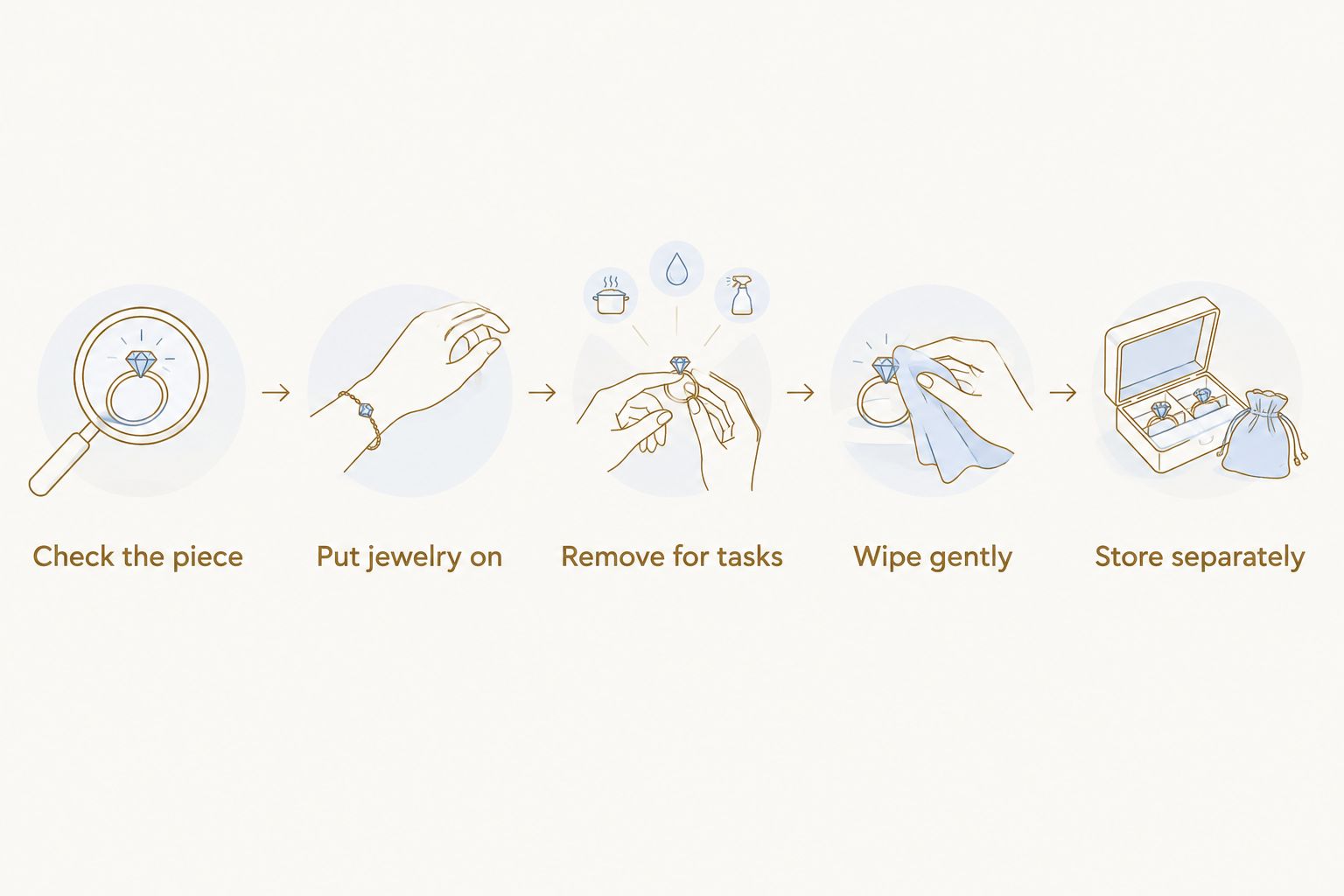
Check the piece. Look for a loose stone, a bent hook, a clasp that does not close, or a chain that catches. Stop wearing a damaged piece until a jeweler assesses it.
Put jewelry on last. Finish applying lotions, perfume, and hair products before dressing in gemstone jewelry. Avoid spraying products directly onto stones or metal.
Remove for tasks. Take labradorite off before exercise, swimming, showering, cleaning, gardening, or working with tools. Choose removal rather than trying to keep the piece out of the way.
Wipe gently. After wear, use a soft, clean cloth to remove surface residue. Do not scrub the stone with abrasive materials.
Store separately. Use a soft pouch or a separate compartment. Keep chains untangled and stones away from loose, harder jewelry.
Daily wear works best when removing and storing jewelry are part of the routine.
Make this your 2026 care habit: keep a soft pouch somewhere you already pause before active tasks. Do not leave a necklace or earrings loose on a sink edge while you wash or shower. A deliberate storage spot prevents an avoidable fall or tangle.
How should you clean labradorite after everyday wear?
Use gentle hand cleaning, not ultrasonic or steam cleaning, for labradorite. Its cleavage makes aggressive cleaning methods a poor choice. The metal, any plating, and other gemstones in the piece can add their own restrictions.
For a piece whose care instructions permit wet cleaning, use lukewarm water, a small amount of mild soap, and a soft cloth or very soft brush. Work gently around the setting without pulling on links or moving the stone. Remove soap residue carefully and dry the jewelry before storing it.
Do not assume the care method for one piece applies to another. Strung jewelry, glued components, mixed gemstones, and different metal finishes need their own instructions. If you do not know the construction or whether the stone has been treated, ask the seller or a jeweler before soaking it.
Keep abrasive pastes, household cleaners, and metal-polishing compounds away from the stone. A product meant to polish metal is not automatically suitable for the gemstone or for a plated finish. Clean the whole piece according to its most delicate component.
When should you stop wearing a labradorite piece?
Remove the jewelry if the gemstone moves in its setting, a hook changes shape, a clasp fails to close, or a new chip leaves a rough edge. Do not keep wearing a damaged piece to see whether it holds together. A jeweler can check the stone and the surrounding construction.
Inspect gently rather than pressing on the gemstone or trying to tighten a setting yourself. Also separate ordinary changes in viewing angle from physical damage: labradorite's flash changes as the stone and light move. A different-looking flash is not, by itself, evidence that the surface has worn away.
For a gift, include the same practical advice you would follow yourself. Parken Jewelry handmade gemstone jewelry fits gifting and self-expression, but the recipient still needs to know when to remove it. A small care reminder is more useful than calling any gemstone piece maintenance-free.
FAQ
Can you wear labradorite every day in 2026?
Yes, you can wear labradorite every day in 2026 if you protect it from impacts, scratches, and unsuitable cleaning methods. Remove it for showering, swimming, exercise, sleep, and hands-on work.
Can I shower with a labradorite necklace?
Take a labradorite necklace off before showering. Soap, hair products, snagging, and the care needs of the chain or setting make removal the simpler choice.
Can I sleep in labradorite earrings?
Remove labradorite earrings before sleeping. Pressure and snagging can affect hooks, settings, and stones, even if the earrings feel comfortable while you are awake.
Is labradorite hard enough for an everyday ring?
Labradorite has a Mohs hardness of 6–6.5, but an everyday ring also needs protection from impact. Choose another jewelry placement if you rarely remove rings for chores or active work.
Are labradorite earrings better than bracelets for daily wear?
Labradorite earrings face fewer direct knocks from desks, counters, and tools than bracelets. Long earrings still need protection from catching on hair, scarves, and clothing.
Can I clean labradorite in an ultrasonic cleaner?
Do not use an ultrasonic cleaner for labradorite. Choose gentle hand cleaning that also follows the care instructions for the metal, setting, and any other gemstones.
Does labradorite lose its flash when worn every day?
Daily wear does not inherently remove labradorite's flash, which comes from its internal structure. Surface dirt can obscure its appearance, while scratches or damage require assessment rather than more aggressive cleaning.
How should I store labradorite jewelry after wearing it?
Store labradorite jewelry separately in a soft pouch or its own compartment. Dry it first and keep the gemstone from rubbing against harder jewelry.
One last thing
Labradorite does not need to look bright from every angle to be beautiful. Its flash depends on how light meets its internal structure, so turn the stone gently in daylight before deciding that it looks dull. Clean visible residue carefully rather than polishing harder in pursuit of constant shine.
Your best everyday piece is the one you remember to take off. Enjoy the color during your day, then give the stone, chain, and setting a protected place to rest.



Leave a comment