Can Birthstone Jewelry Be Resized? Yes, With Limits | 2026
By Editorial Team
Yes, birthstone jewelry can often be resized or adjusted, but the metal, gemstone, setting, and construction determine what a jeweler can safely change. A ring needs a different repair from a necklace or bracelet, and the work must protect both the stone and the parts holding it in place.
TL;DR
Can birthstone jewelry be resized? Often yes, but construction matters more than the birthstone month.
Birthstone rings need a setting inspection before resizing; necklaces and bracelets need a chain or strand assessment.
An extender adds necklace length without cutting the original chain, but it changes the clasp area.
Parkenjewelry suits women seeking handmade minimalist gemstone jewelry for themselves or gifts, not a guaranteed resizing solution.
Why this matters
A birthstone gift can have personal meaning and still fit badly. Before replacing it, find out whether the problem is the ring size, chain length, clasp position, or the way the piece sits when you move.
Change the fit without treating the gemstone as an afterthought. For your 2026 jewelry-care checklist, pair a fit assessment with appropriate cleaning advice: the guide to cleaning gemstone jewelry at home covers a separate part of keeping your piece wearable. Resizing is repair work, not an opportunity to use aggressive cleaning or heat on an unidentified stone.
Can birthstone jewelry be resized?
Yes, many birthstone pieces can be adjusted, but not every design allows the same method. Start with the type of jewelry rather than the gemstone's name.
Jewelry type
Possible adjustment
Best for
Main limitation
Ring
Alter the band or assess a removable fit aid
Changing finger fit
Stones, settings, and band construction can restrict alteration
Chain necklace
Shorten the chain, add a compatible extender, or replace a removable chain
Changing where a pendant rests
Fixed pendants and decorative links complicate changes
Chain bracelet
Remove suitable links or assess an extension
Adjusting wrist fit
The clasp and decorative pattern must remain functional
Beaded necklace or bracelet
Restring with a revised arrangement
Changing the length of a strung piece
The bead sequence and balance can change
Earrings
Assess a closure or component change rather than standard resizing
Addressing a specific fit problem
Alteration can change weight, movement, or security
This table describes repair approaches, not permission to alter your piece at home. A jeweler needs to inspect the actual construction before choosing a method.
When you ask for an assessment in 2026, describe the result you want: a ring that stays in place, a bracelet that does not slide over your hand, or a pendant that rests above your neckline. That is more useful than asking whether a particular birthstone is resizable.
Birthstone rings: inspect the band and setting first
A jeweler can resize many precious-metal rings by changing the band and restoring its shape. That process also affects the part of the ring supporting the setting, so the stone's security matters as much as the new finger size.
A plain section of band generally gives a jeweler more room to work than stones set all the way around. Full-eternity designs are more restrictive because changing the circumference changes the relationship between their settings. Engraving and detailed patterns introduce another concern: the finished repair must preserve the design, not just produce a different diameter.
Increasing a ring's size and decreasing it are not interchangeable jobs. A larger change can affect the ring's shape and the way its settings hold the stones. There is no universal safe adjustment that applies to every birthstone ring.
Ask the jeweler to check:
Whether the band has an appropriate place for alteration.
Whether the gemstone needs removal or protection during the work.
Whether reshaping the ring will affect its settings.
Whether engraving or surface detail will be interrupted.
Whether an existing repair changes the proposed approach.
A fit aid is another option to assess when a ring feels loose. Its advantage is that it can address fit without the same permanent band alteration; its drawback is that it changes how the ring feels against your finger. Choose a fit aid only after checking comfort and security.
Birthstone necklaces: change the length, not necessarily the pendant
Necklace resizing usually means changing the chain or strand length. The gemstone itself does not need to change size.
For a pendant that slides freely on a removable chain, a different compatible chain can solve the fit problem without altering the pendant. Check that the chain passes through the pendant's opening and that the clasp closes securely. A chain that looks suitable is not automatically a mechanical fit.
An extender is best for adding length without cutting the original chain. It keeps the adjustment at the clasp area, but adds another connection and changes what sits at the back of your neck. Check the extender's connection and metal compatibility before wearing it.
Shortening a chain is a permanent change unless the construction allows another adjustment later. Ask to retain any removed section; it can help a jeweler assess future restoration, although rejoining it is not guaranteed.
Fixed gemstone stations, decorative drops, and multiple pendants require more planning. Removing length from the wrong place can shift the focal point or leave the necklace sitting unevenly. Lay the necklace flat before discussing where any alteration should happen.
For a gift, do not assume the recipient wants the same pendant position you do. A necklace that suits one neckline can sit awkwardly with another.
Birthstone bracelets: preserve the clasp and pattern
A chain bracelet can sometimes be shortened by removing appropriate links. A beaded bracelet usually needs a different approach: restringing rather than cutting and reconnecting a metal chain.
The best adjustment leaves the clasp usable and the design balanced. Removing a decorative section just because it is convenient can leave a bracelet fitting better but looking unfinished.
For bracelets with gemstone stations, ask how the new length changes the spacing. For strung bracelets, ask whether the jeweler will preserve the bead order and replace the stringing material as part of the work. Do not cut an elastic or threaded bracelet to test a shorter arrangement yourself.
A bracelet also needs to pass a movement check. Try it while bending your wrist and opening your hand, not only while holding your arm still. The right fit should meet your comfort preference without letting the bracelet slip off or putting constant strain on the closure.
Birthstone earrings: fit changes are not standard resizing
Earrings do not usually have a size in the same sense as rings. A fit problem can involve the closure, post, ear wire, drop length, or weight.
A closure change is best for a specific fastening problem, but it does not automatically solve discomfort caused by weight. Shortening a drop changes the proportions and movement of the design. Treat those as separate decisions.
Tell the jeweler what feels wrong before asking for a component change. If an earring pulls, turns, or catches on clothing, describe that behavior. Avoid bending posts or ear wires at home; a part that appears to hold its new shape can still be weakened by the alteration.
Why birthstone jewelry resizing varies
The birthstone month does not determine the repair method. These construction details do:
Metal: Solid precious metal, gold-filled material, and plated material have different structures. A repair must account for the surface as well as the underlying metal.
Gemstone: Stone identity, treatments, inclusions, and condition affect how it tolerates handling and heat.
Setting: Prongs, bezels, and closely spaced settings respond differently when nearby metal moves.
Construction: A removable pendant offers different options from a fixed station necklace or a strung bracelet.
Design: Engraving, repeated patterns, and gemstone spacing can limit where material is added or removed.
Condition: Worn links, loose stones, and earlier repairs need attention before a fit adjustment proceeds.
The practical rule is simple: confirm the material and construction before choosing the repair. A piece being handmade does not prove it is adjustable, and a piece being small does not make the work simple.
Gemstone hardness does not tell you whether resizing is safe
The Mohs scale describes resistance to scratching, not resistance to repair heat. GIA's gemstone-care guidance distinguishes hardness from toughness and stability; those distinctions matter when a jeweler handles a set stone.
For this 2026 guide, three established examples show why a birthstone name alone is insufficient:
Gemstone
Mohs hardness
What the number does not establish
Amethyst
7 on the Mohs scale
Whether heat or a particular repair method is safe
Opal
5–6.5 on the Mohs scale
Whether the stone tolerates temperature changes
Pearl
2.5–4.5 on the Mohs scale
Whether heat or chemicals are appropriate
Amethyst's hardness of 7 does not make every amethyst ring safe to resize with the stone in place. Opal's hardness of 5–6.5 and pearl's hardness of 2.5–4.5 likewise do not provide a repair instruction.
Ask the jeweler to assess the actual gemstone, including known treatments. A stone's trade name or color is not a substitute for identification.
How do you get birthstone jewelry resized safely?
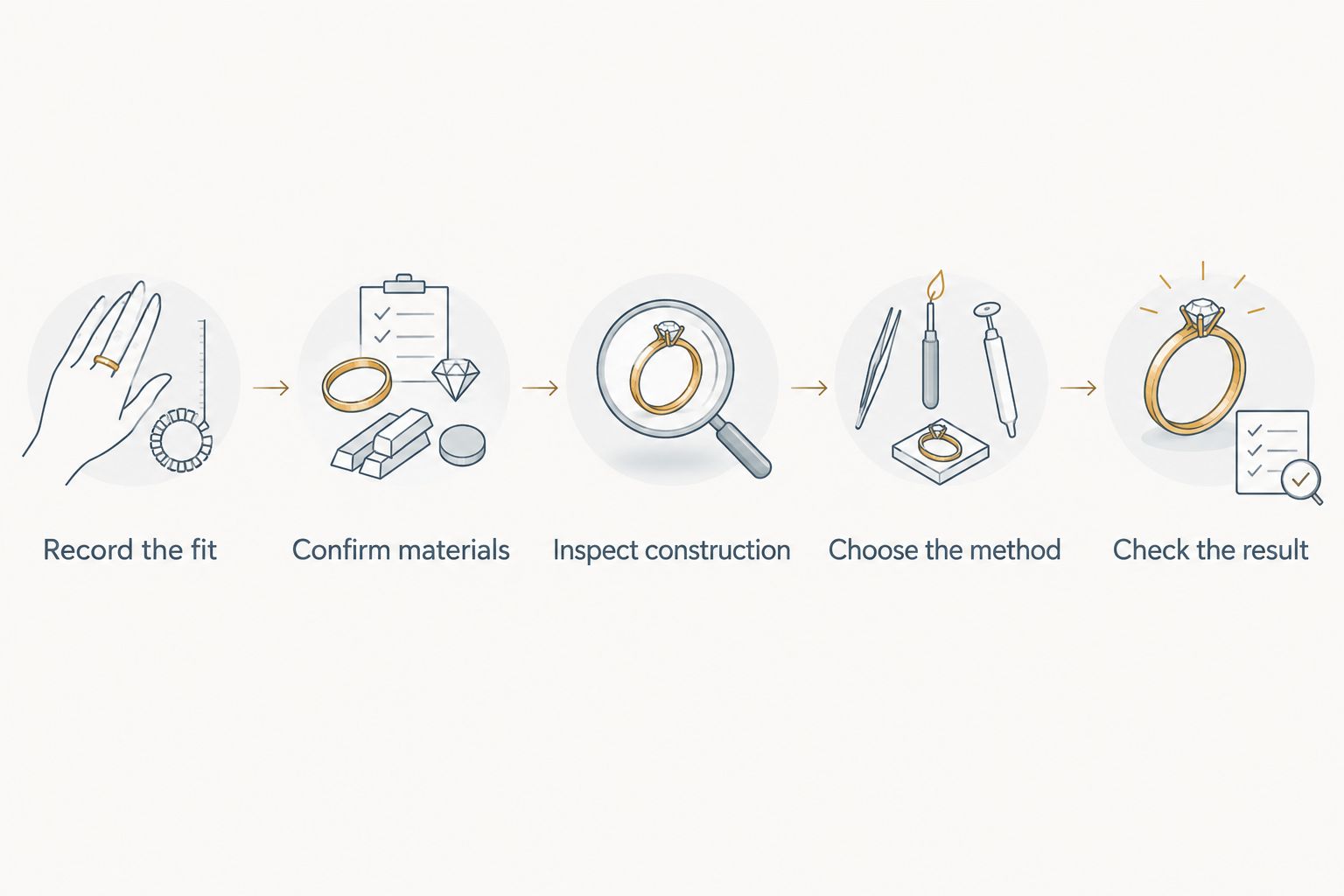
Use this sequence for a 2026 repair appointment. It keeps the conversation focused on fit while giving the jeweler the information needed to protect the piece.
Record the fit. Explain what happens when you wear it: slipping, pinching, twisting, or resting in the wrong place. Bring a piece that fits well if it offers a useful comparison.
Confirm materials. Bring the product description, receipt, or any gemstone documentation you have. Ask the jeweler to verify anything uncertain rather than working from color alone.
Inspect construction. Have the jeweler examine the stone, setting, clasp, links, and signs of previous repair. Existing damage can change the order of the work.
Choose the method. Compare a permanent alteration with a compatible extender, removable chain replacement, or another suitable fit solution. Ask what each method changes visually.
Check the result. Try the finished piece, operate the clasp, and inspect the gemstone position. Ask the jeweler to confirm that the setting and repaired connections are secure.
Confirm the materials and construction before choosing a resizing method.
Keep the original components if the repair removes them. Photograph the piece before alteration so you can explain the details you want preserved, especially a pendant's position or a bracelet's gemstone sequence.
Choosing handmade gemstone jewelry with fit in mind
Parkenjewelry is best for women who want handmade minimalist gemstone jewelry for themselves or gifts. The collection includes necklaces, bracelets, and earrings crafted in precious metals in New York City.
The advantage is that you can choose the type of jewelry around the recipient's habits rather than defaulting to a ring. The limitation is that handmade construction does not guarantee future resizing; every design still needs its own fit and repair assessment.
When considering Parkenjewelry gemstone jewelry in 2026, check the stated dimensions, materials, and closure details before choosing a piece. Ask about adjustment options for the exact design rather than assuming every necklace or bracelet allows the same change.
For a personal gift, use a necklace or bracelet the recipient already enjoys as a fit reference. That preserves the surprise without making their birthstone do all the decision-making.
Can I make a birthstone necklace longer without cutting it?
Yes, a compatible chain extender can add length without cutting the original chain. This is best for a clasp-based adjustment, but the extra connection must suit the chain and close securely.
A removable pendant offers another option: use a compatible longer chain. Confirm that the pendant opening accommodates it before making the change.
Will resizing damage my birthstone?
Resizing can damage a gemstone if the repair exposes it to unsuitable heat, pressure, or handling. A jeweler's assessment determines whether the stone needs protection, removal, or a different repair approach.
Do not use scratch resistance as reassurance. The setting and the gemstone's stability both matter.
FAQ
Can birthstone jewelry be resized after I receive it as a gift?
Yes, many birthstone pieces can be adjusted after gifting, but the construction determines the method. Have a jeweler assess the fit, metal, gemstone, and setting before altering it.
Can every birthstone ring be made bigger?
No, not every birthstone ring can safely be made bigger. Stones around the full band, delicate settings, and the band's construction can restrict the change.
Can a jeweler shorten a birthstone bracelet?
Yes, a jeweler can shorten some birthstone bracelets by removing suitable links or restringing the piece. The adjustment must preserve the clasp function and account for the gemstone pattern.
Is a chain extender better than resizing a birthstone necklace?
A compatible chain extender is better when you want added length without cutting the original chain. Its drawback is the additional connection at the clasp area; shortening requires a different solution.
Can I resize gold-filled birthstone jewelry at home?
Do not resize gold-filled birthstone jewelry at home. Its layered construction and the gemstone setting need assessment before cutting, bending, or heating.
Does Parkenjewelry handmade gemstone jewelry guarantee an adjustable fit?
Handmade gemstone jewelry does not automatically guarantee an adjustable fit. Before choosing a Parkenjewelry piece in 2026, ask about the dimensions and adjustment options for that exact design.
One last thing
Check where the jewelry sits before deciding how much to change it. A pendant that feels too long with one neckline can work with another, and a bracelet can feel different when worn beside a watch.
Wear the piece with the clothes and accessories you actually use. Then describe the fit problem to the jeweler. That small check helps you request the right alteration instead of permanently changing a meaningful gift to solve the wrong problem.



Leave a comment