Cart
Your cart is empty
Looks like you haven’t added anything yet, browse new arrivals below!
Continue Shopping
Looks like you haven’t added anything yet, browse new arrivals below!
Continue Shopping
To tell if gemstone jewelry is real, check the exact stone description, inspect it without damaging it, and use a qualified gemologist when you need confirmation. Color, weight, a metal stamp, or a photograph cannot prove a gemstone’s identity or natural origin. In 2026, the safest approach is to separate what the seller claims from what an examination can establish.
A necklace can be beautifully made while its gemstone description leaves important questions unanswered. You need to know what the stone is, whether it formed naturally or in a laboratory, and whether it has received treatments. Those are separate questions, not different ways of asking whether it looks genuine.
The metal needs its own check. Understanding whether gold-filled is the same as solid gold helps you assess a jewelry description, but a metal marking does not authenticate the stone attached to it.
Buy the description you can verify, not the appearance you hope means natural. That matters whether you are choosing a gift for your mom, a friend, or yourself.
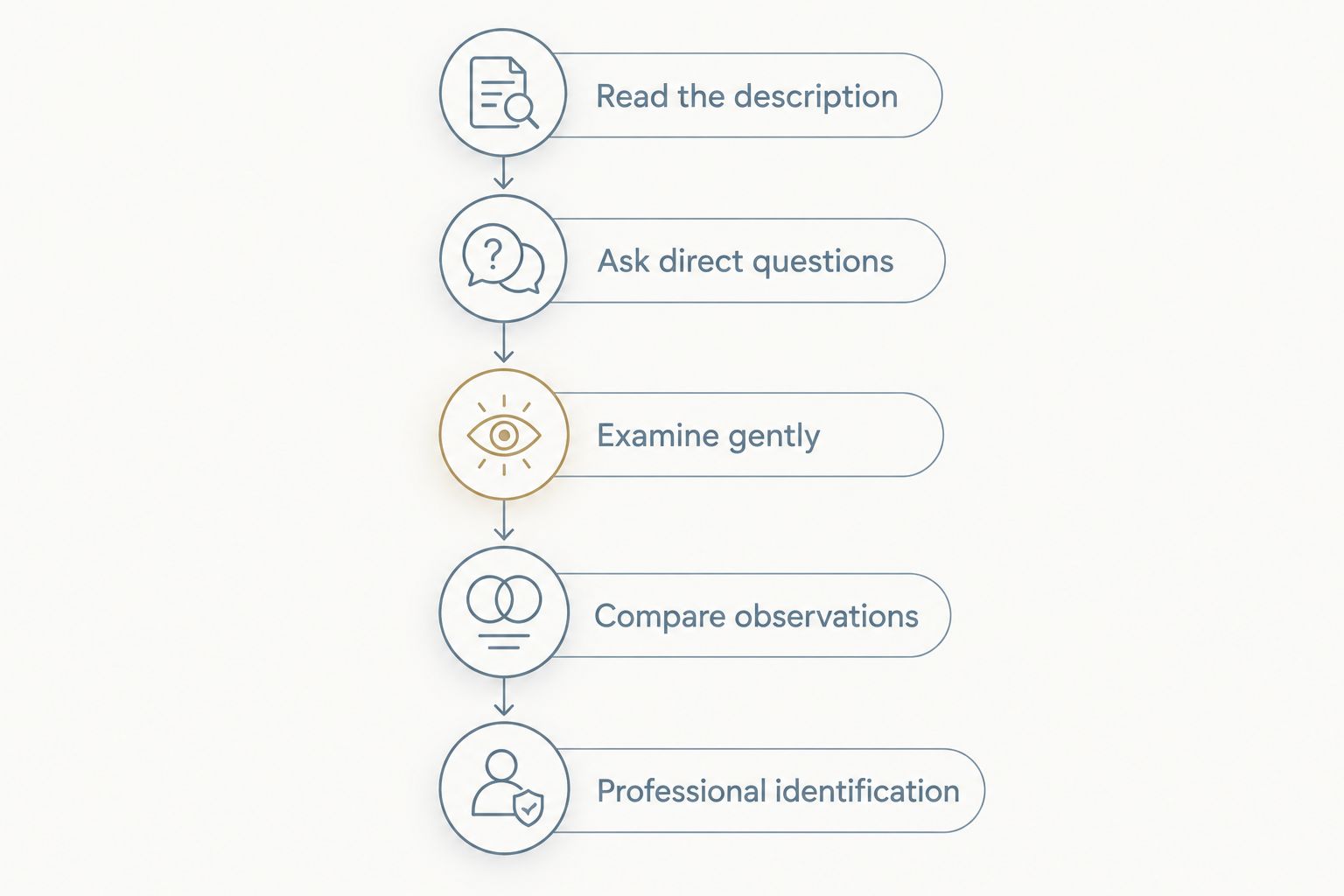
Follow these steps before drawing a conclusion. Start with written information, then move to careful observation, and leave identification tests to someone trained to interpret them.
Look for the gemstone’s name and any words describing its origin or treatment. Natural, laboratory-grown, simulated, dyed, coated, and fracture-filled do not mean the same thing. A color name alone does not identify a mineral.
Save the description with your purchase records. For a 2026 purchase, keep a dated copy of the listing and any written answers from the seller; that records the actual claim you are checking.
Ask: What material is the stone? Is it natural, laboratory-grown, or an imitation? What treatments are disclosed?
Keep the questions separate. A seller saying that a stone is genuine has not necessarily answered whether its color is natural or whether it formed underground. Ask for plain language rather than interpreting a reassuring adjective.
Use good light and a clean viewing surface. Turn the piece slowly and look at the stone from different angles, including its sides and back where the setting allows.
A 10× loupe is useful for examining small surface and internal details. Its benefit is visibility; its limitation is interpretation. A magnified feature becomes meaningful only when someone knows what it indicates for that particular material.
Notice color distribution, surface wear, internal features, and any apparent coating. Write down what you see rather than immediately labeling the piece genuine or fake.
A stone that looks unexpectedly uniform deserves a question, not an automatic rejection. A stone with visible inclusions deserves the same restraint: natural and laboratory-grown materials can both contain internal features.
Ask a qualified gemologist whether the mounted stone can be identified and whether its natural or laboratory-grown origin can be determined. For more involved questions, a gemological laboratory can explain the appropriate report and any testing limitations.
Professional identification is the strongest next step when the answer affects your buying decision. Do not turn an uncertain home observation into a definite claim.
A natural gemstone formed through natural processes rather than laboratory production. Natural does not automatically mean untreated, flawless, or suitable for every kind of wear.
Best for: someone who specifically wants a naturally formed stone. The advantage is that origin matches that preference; the limitation is that appearance alone cannot establish it. You still need treatment information and care instructions for the particular material.
Laboratory-grown gemstones have essentially the same chemical composition, crystal structure, and physical properties as their natural counterparts. Synthetic ruby is ruby, for example, but its growth origin is different from natural ruby.
Best for: someone who accepts laboratory origin and wants the named gemstone material. The advantage is that laboratory-grown does not mean a look-alike substitute; the limitation is that distinguishing origin can require specialized testing.
A clear description should say laboratory-grown or synthetic rather than leaving you to assume natural origin.
An imitation resembles another gemstone without being that gemstone material. Glass made to resemble emerald is not emerald, even if its color is attractive.
Best for: someone choosing an appearance and knowingly accepting a substitute material. The advantage is that an openly described imitation can serve a decorative purpose; the limitation is that its properties and care needs differ from those of the gemstone it resembles.
Use this comparison when reading a jewelry listing in 2026:
| Category | What it means | What appearance cannot establish | Main limitation |
|---|---|---|---|
| Natural gemstone | Formed in nature | Natural origin or treatment history | Natural does not mean untreated |
| Laboratory-grown gemstone | Laboratory-produced counterpart of a natural gem | Whether it formed naturally or in a laboratory | Origin can require specialized testing |
| Imitation gemstone | Different material resembling another gem | Whether the claimed gemstone material is present | Resemblance does not mean matching properties |
A treated natural gemstone still belongs in the natural category. Treatment is another layer of information, not a fourth growth origin.
There is no reliable visual rule that works for every necklace, bracelet, and pair of earrings. These factors change what you can learn from an examination:
This is why a photograph can help you choose a style but cannot replace identification. Ask for another view when useful, while keeping the limits of photography in mind.
Inclusions are clues, not proof of natural origin. They can include crystals, growth features, fractures, or trapped fluids. Their shape and arrangement matter more than their mere presence.
Round bubbles can occur in glass, but bubble-like features also need careful interpretation. A phone photograph or a quick loupe inspection is not enough to conclude that every rounded feature means imitation.
Likewise, a clear stone is not automatically fake. Do not use visible imperfection as a shopping requirement. Instead, ask whether a trained examiner can connect the observed features to a specific identification.
A metal stamp does not prove a gemstone is real. It concerns the metal rather than the stone, and assessing the marking itself is a separate task.
Even a correctly described precious-metal setting can hold a natural stone, a laboratory-grown stone, or an imitation. Handmade construction also describes how jewelry was made, not how its gemstone formed.
Parken Jewelry is best for women seeking handmade minimalist gemstone jewelry for themselves or gifts. The collection includes necklaces, bracelets, and earrings crafted in precious metals in New York City. That tells you the brand’s category and craftsmanship focus; it does not replace stone-specific origin and treatment information.
You can inspect gemstone jewelry at home without damaging it, but you cannot reliably settle every identification question there. Keep home checks observational: read, photograph, magnify, and ask.
Avoid scratch tests, hot needles, flame, acids, and household chemicals. These can damage stones, finishes, adhesives, or settings. Do not remove a mounted stone just to make a home test easier.
Hardness figures explain why a scratch test is misleading. Quartz measures 7 on the Mohs scale, corundum measures 9 on the Mohs scale, and diamond measures 10 on the Mohs scale, as recorded in standard mineral references. Mohs hardness describes resistance to scratching, not resistance to breaking, and the scale is not linear.
A scratch therefore does not establish natural origin. Natural and laboratory-grown counterparts can share hardness, while a careless test can leave permanent damage. In 2026, choose non-destructive inspection and professional interpretation instead.
Read a report for its actual findings rather than treating the word certificate as a guarantee. Look for the issuing laboratory, report identifier, description of the examined item, material identification, and any stated origin or treatment findings.
Laboratories such as the Gemological Institute of America offer colored-stone identification services. Report scope varies, so distinguish growth origin from geographic origin; they answer different questions.
Also distinguish identification from appraisal. An identification report concerns the material and findings within its scope. An appraisal addresses value for a stated purpose and is not automatically a substitute for laboratory identification.
If a report accompanies a 2026 purchase, ask how it corresponds to the piece you are buying. Compare the item description and recorded characteristics, and verify the report through the issuer’s own process where available.
Keep the conversation simple and specific. You do not need technical vocabulary to ask for clear material information.
For Parken Jewelry gemstone jewelry, use the same questions you would use with any seller. Choose the shape and color for the recipient, then confirm the material details separately.
If natural origin is essential to your gift, resolve that question before buying. A thoughtful gift should match what you intend to give, without asking the recipient to investigate afterward.
How can I tell if gemstone jewelry is real from a picture?
A picture cannot confirm gemstone identity or natural origin. Use photographs to assess appearance, then check written disclosures and seek professional identification when certainty matters.
Does a real gemstone always have imperfections?
No, visible imperfections are not required for a gemstone to be natural. Natural stones can look clear, and laboratory-grown stones can contain inclusions.
Are laboratory-grown gemstones fake?
Laboratory-grown gemstones are not the same as imitations. They have essentially the same chemical composition, crystal structure, and physical properties as their natural counterparts, but a different growth origin.
Does a cold gemstone mean it is real?
No, feeling cold does not establish gemstone identity. Touch is not a reliable way to distinguish natural gemstones, laboratory-grown gemstones, and look-alike materials.
Can I scratch a gemstone to check whether it is genuine?
Do not scratch gemstone jewelry to authenticate it. Scratching can damage the piece and cannot establish natural origin.
Does handmade jewelry guarantee natural gemstones?
No, handmade describes the jewelry’s construction rather than the gemstone’s origin. For Parken Jewelry or any other seller, ask about the specific stone’s material, growth origin, and disclosed treatments.
Who can confirm whether my gemstone jewelry is genuine?
A qualified gemologist or gemological laboratory can assess gemstone identity using appropriate tests. Ask whether the examination also addresses natural versus laboratory-grown origin and treatments.
The most useful question is not simply whether a stone is real. Ask whether it is the material and origin described by the seller.
A disclosed laboratory-grown gem and a disclosed imitation are different from a misrepresented stone. For your 2026 jewelry purchases, keep the written description, avoid damaging tests, and make unanswered material questions part of your buying decision.

Subscribe to our email list to get early access to new arrivals and exclusive offers.
Leave a comment