Cart
Your cart is empty
Looks like you haven’t added anything yet, browse new arrivals below!
Continue Shopping
Looks like you haven’t added anything yet, browse new arrivals below!
Continue Shopping
Yes, gemstone bracelets can be adjusted when their design includes a slider clasp, an extender, or several fastening positions. A fixed-length bracelet needs a separate alteration, such as changing chain links or restringing beads, rather than a simple clasp adjustment. Check the fastening first: adjustable does not mean every bracelet fits every wrist.
A bracelet should feel comfortable when you move, not just look right when your hand rests on a table. Too much movement lets the stones turn underneath your wrist; too little room makes the bracelet feel restrictive.
Parken Jewelry is best for women seeking handmade minimalist gemstone jewelry for themselves or a gift. When browsing Parken Jewelry, choose the fastening with the same care you give the gemstone color. Handmade describes how a piece is made, not whether its length changes.
For a 2026 jewelry purchase, separate three questions: does the bracelet adjust, does its adjustment range suit your wrist, and can you operate the closure comfortably? Answering only the first leaves the actual fit unresolved.
Yes, but the adjustment method depends on the bracelet’s construction. A sliding clasp changes the wearable loop, an extender gives you different places to fasten, and a stretch bracelet expands to pass over your hand without offering a selectable clasp position.
The distinction is simple: adjustment uses the bracelet’s existing hardware; resizing changes the bracelet itself. Before choosing either route, identify the closure and check the maker’s instructions.
| Bracelet construction | How the fit changes | Best for | Advantage | Limitation |
|---|---|---|---|---|
| Slider clasp | Chain moves through a purpose-built sliding closure | Fine-tuning the fit | Lets you change the loop without removing links | Adjustment stops at the design’s physical limits |
| Extender chain | Clasp attaches at different points along an extension | Choosing between fastening positions | Makes the adjustment points easy to see | Positions are spaced rather than continuously variable |
| Fixed-length chain | A jeweler changes compatible links or components | Keeping a preferred bracelet with a different fit | An alteration can preserve a piece you already enjoy | Suitability depends on the construction |
| Stretch-bead strand | Elastic expands over the hand; resizing requires restringing | Slipping a bracelet on without a clasp | No clasp to operate | Stretch is not a permanent size adjustment |
| Rigid bangle | Fit depends on the opening and internal shape | Wearing a bracelet with a set shape | Holds its shape rather than draping | Not automatically adjustable; do not bend it to fit |
An open-ended bracelet also needs its own instructions. A gap between the ends is not permission to repeatedly bend the metal, especially when gemstones or settings sit near the area you would move.
A slider clasp is designed to change the bracelet’s wearable loop. Follow the maker’s directions and support the closure while moving the chain; do not use the gemstone section as a handle.
Make a gentle adjustment, then release the chain and check how the bracelet sits. If the slider sticks, the chain catches, or a connection looks strained, stop rather than pulling harder.
Best for: a wearer who wants to fine-tune the fit without changing the bracelet’s construction. The benefit is flexibility. The limitation is that the slider still has an endpoint, and the bracelet must open far enough to go on comfortably.
For a 2026 gift, ask about both the wearable range and how the bracelet goes on. A closure that adjusts neatly once worn still needs to suit the recipient’s hand and comfort with handling small jewelry.
An extender chain lets you secure the clasp at different points. Open the clasp, choose an intended fastening link, and close it fully before checking the fit.
Do not attach the clasp to a gemstone connection just because that point gives the length you want. Use the parts intended for fastening, and check that the clasp closes without pressing against another component.
Best for: someone who prefers visible, repeatable fastening positions. The advantage is a clear choice of lengths. The limitation is that the available positions do not provide every possible fit, and the unused extension hangs beyond the clasp.
Check the finished position with your wrist relaxed. If the extension catches on a sleeve, change to another intended fastening position only if the bracelet remains comfortable.
A fixed-length bracelet does not become adjustable because it has a clasp. Its clasp opens the bracelet; it does not necessarily offer another wearable length.
A jeweler can assess whether changing chain links, replacing a component, or restringing a bead strand suits the design. Gemstone placement, connections, and the pattern all matter, so the right alteration is specific to the piece.
Best for: keeping a bracelet you like when its existing length does not suit you. The benefit is retaining the piece. The limitation is that an alteration can affect the spacing or balance of its design.
Before authorizing work, ask what will change and how the stones will sit afterward. For a bracelet with a centered gemstone, shortening only one side can shift the visual center relative to the clasp.
Measure where you intend to wear the bracelet, then compare that measurement with the maker’s sizing guidance. Your wrist measurement is a starting point, not automatically the finished bracelet length.
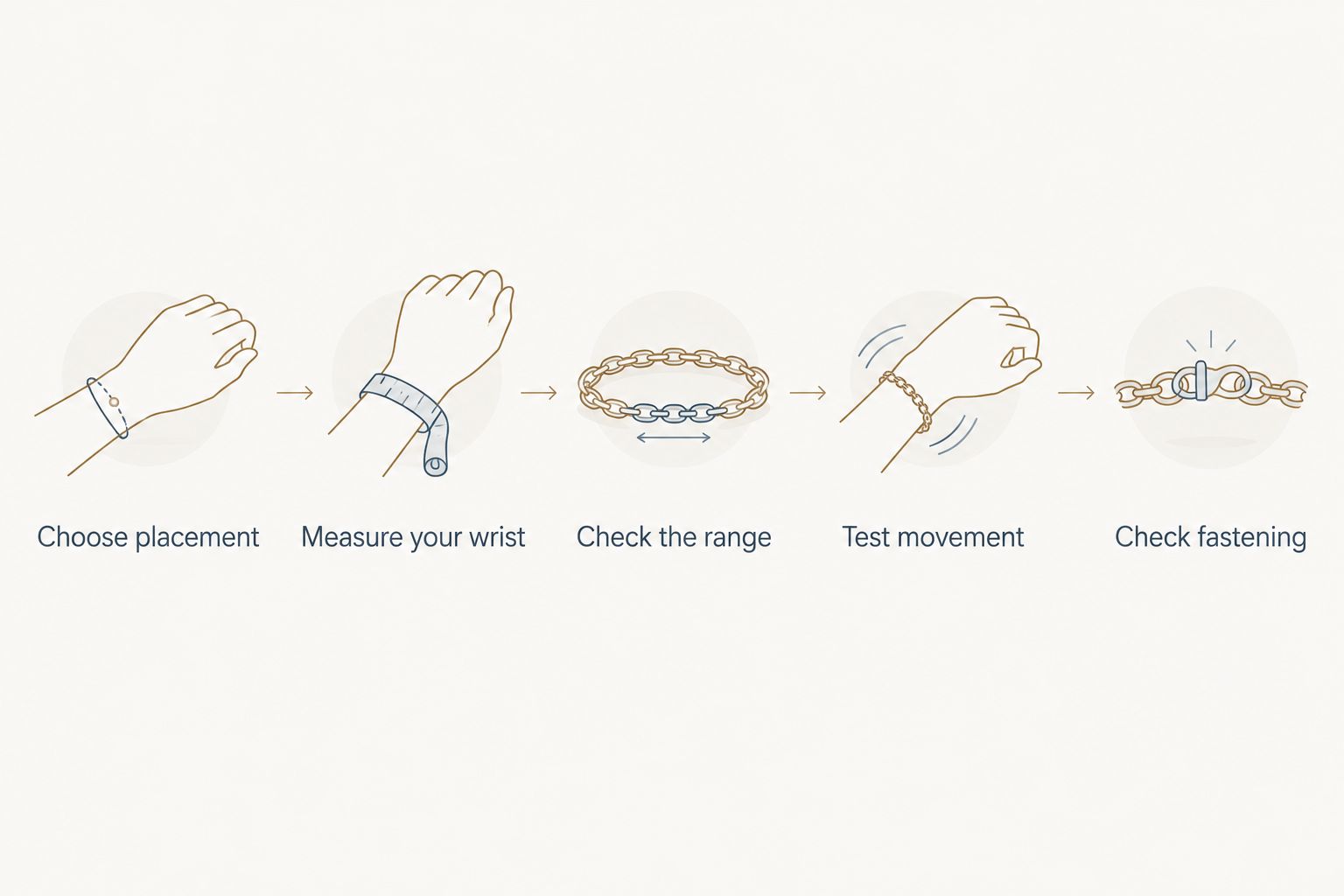
Use the bracelet’s own sizing instructions instead of adding an arbitrary amount to your wrist measurement. Bead size, chain construction, and the way a piece drapes all affect how a stated length feels.
When comparing bracelets in 2026, keep your measurements in the same unit as the product’s sizing information. If you convert between inches and centimeters, retain the original measurement so you can check your calculation before ordering.
Parken Jewelry’s gemstone bracelet descriptions include adjustable designs, but choose by the details of the individual piece rather than assuming every bracelet uses the same closure. These two examples illustrate that distinction.
| Bracelet | Confirmed adjustment detail | Best for | What to check |
|---|---|---|---|
| Rose Quartz Adjustable Gemstone Bracelet | Handmade with an adjustable slider clasp | Someone who wants rose quartz and a stated slider closure | Usable sizing range and closure instructions |
| Aqua Blue Chalcedony Adjustable Gold Gemstone Bracelet | Described as adjustable, with bezel gemstones and tiny stone accents | Someone who wants aqua blue chalcedony in an adjustable design | Closure type, usable sizing range, and how it goes on |
The Rose Quartz Adjustable Gemstone Bracelet has the clearer closure description: its listing specifies a slider clasp. The Aqua Blue Chalcedony Adjustable Gold Gemstone Bracelet confirms adjustability, but that detail alone does not explain how you operate it.
The advantage is an adjustable design; the limit is that the description does not replace a fit check. For either bracelet, confirm the measurements you need before choosing it for yourself or someone else.


The gemstones do not determine adjustability on their own. The closure and construction decide whether you can change the fit at home or need an alteration.
For a 2026 purchase, ask for sizing information tied to the exact bracelet. Details from a similar-looking necklace or another bracelet do not establish this piece’s fit.
You can make an adjustable gemstone bracelet smaller at home by using its intended slider or fastening positions. You cannot safely assume a fixed-length bracelet offers the same option.
Do not cut a chain, open gemstone connections, or remove beads as a casual fit adjustment. If the bracelet remains loose at its shortest intended setting, ask the maker or a jeweler to assess resizing.
An adjustable gemstone bracelet is a good gift when its usable range suits the recipient and the closure is comfortable for them to handle. It gives you room to adjust the fit, not a guarantee that wrist measurements are unnecessary.
For a surprise gift, ask about a bracelet the recipient already wears comfortably. Confirm the chosen design’s measurements and instructions before ordering; appearance alone cannot establish the fit.
Can gemstone bracelets be adjusted for a small wrist?
Yes, an adjustable gemstone bracelet can fit a small wrist if its shortest usable setting suits that wrist. If it remains loose at that setting, it needs a different size or an assessment for alteration.
Can you make a gemstone bracelet bigger?
You can make an adjustable gemstone bracelet bigger within its intended adjustment range. A fixed-length piece needs an assessment for a compatible extender, a chain alteration, or restringing, depending on its construction.
Is a slider bracelet better than an extender bracelet?
A slider bracelet is better for fine-tuning the loop, while an extender bracelet is better for choosing visible fastening positions. Choose the closure you can handle comfortably and confirm that its usable range fits.
Does a stretch gemstone bracelet count as adjustable?
A stretch gemstone bracelet stretches to go over your hand, but it does not offer a selectable size setting. Changing its resting size requires restringing rather than stretching it farther.
Can I pull on the stones to tighten my bracelet?
No—use the intended closure rather than pulling on the stones or their settings. Support the clasp and follow the maker’s instructions; stop if the chain catches or a connection looks strained.
Does Parken Jewelry resize gemstone bracelets?
Ask Parken Jewelry directly whether resizing is available for the specific gemstone bracelet you have. An adjustable product description establishes an adjustable design, not a separate alteration service.
What should I check before buying an adjustable bracelet in 2026?
Before buying an adjustable bracelet in 2026, check the closure type, usable sizing range, and how the bracelet goes on. Compare those details with your wrist measurement and your preferred fit.
A bracelet can fit around your wrist yet still be awkward to put on. A closed-loop design must pass over your hand, while a bracelet that opens at the clasp follows a different fitting process.
Check both wearing and putting-on comfort before deciding the fit is right. That small distinction is especially useful when you are choosing a thoughtful gift rather than trying the bracelet on yourself.

Subscribe to our email list to get early access to new arrivals and exclusive offers.
Leave a comment