This site has limited support for your browser. We recommend switching to Edge, Chrome, Safari, or Firefox.

Save 20% with Code FALL26

Stacking Bracelets for Nurses: 2026 Guide That Actually Fits

Stacking bracelets for nurses: complete 2026 guide

Stacking bracelets for nurses means choosing adjustable, low-profile pieces you can slip off in one motion at the sink, not fixed bangles you fight with between patients. A nurse's wrist deals with more hand sanitizer, glove friction, and quick removals in a single 2026 shift than most people's wrists see in a month, so the stack has to survive that without dulling, snagging, or slowing anyone down.

TL;DR
  • Stacking bracelets for nurses work best as adjustable cord or chain pieces that come off in one pull, not clasped bangles.
  • Gold-filled and sterling silver hold up to daily hand sanitizer better than gold-plated finishes, which thin out within months of hospital-grade washing.
  • Cap a wrist stack at 2-3 adjustable bracelets under a scrub sleeve; taller stacks catch on gloves and IV tubing.
  • Adjustable stacking bracelets from Parken Jewelry remove with one pull, which fits the quick change between a shift and off-duty hours.

Why stacking bracelets matter for nurses

Most hospitals restrict rings, bracelets, and watches during direct patient care under standard hand hygiene protocols, which means a nurse's jewelry lives in two very different worlds: the twelve hours on the floor, and everything before and after it. That split is why fixed bangles frustrate nurses faster than almost anyone else who shops for stacking bracelets — a bangle that has to be worked over the knuckle five times a day gets left in a locker by week two.

The fix isn't skipping bracelets. It's picking a stack built for fast on, fast off, and enough gemstone variety that the ten minutes before a shift and the hour after it still feel like getting dressed, not just changing out of scrubs.

Update your jewelry policy knowledge before you buy

Every unit has its own line on what's allowed at the bedside, and that line changes what a stacking bracelet needs to do for you.
  • Confirm whether your unit allows bare wrists only during direct patient care, or bans bracelets on the floor entirely
  • Ask whether short breaks and charting time count as "on the floor" for jewelry rules
  • Check if your facility's infection control policy singles out fabric or beaded bands separately from metal
  • Note whether MRI, cath lab, or OR rotations have stricter rules than a general med-surg floor
  • Keep one adjustable piece in your bag as a backup for units with tighter rules than your usual assignment
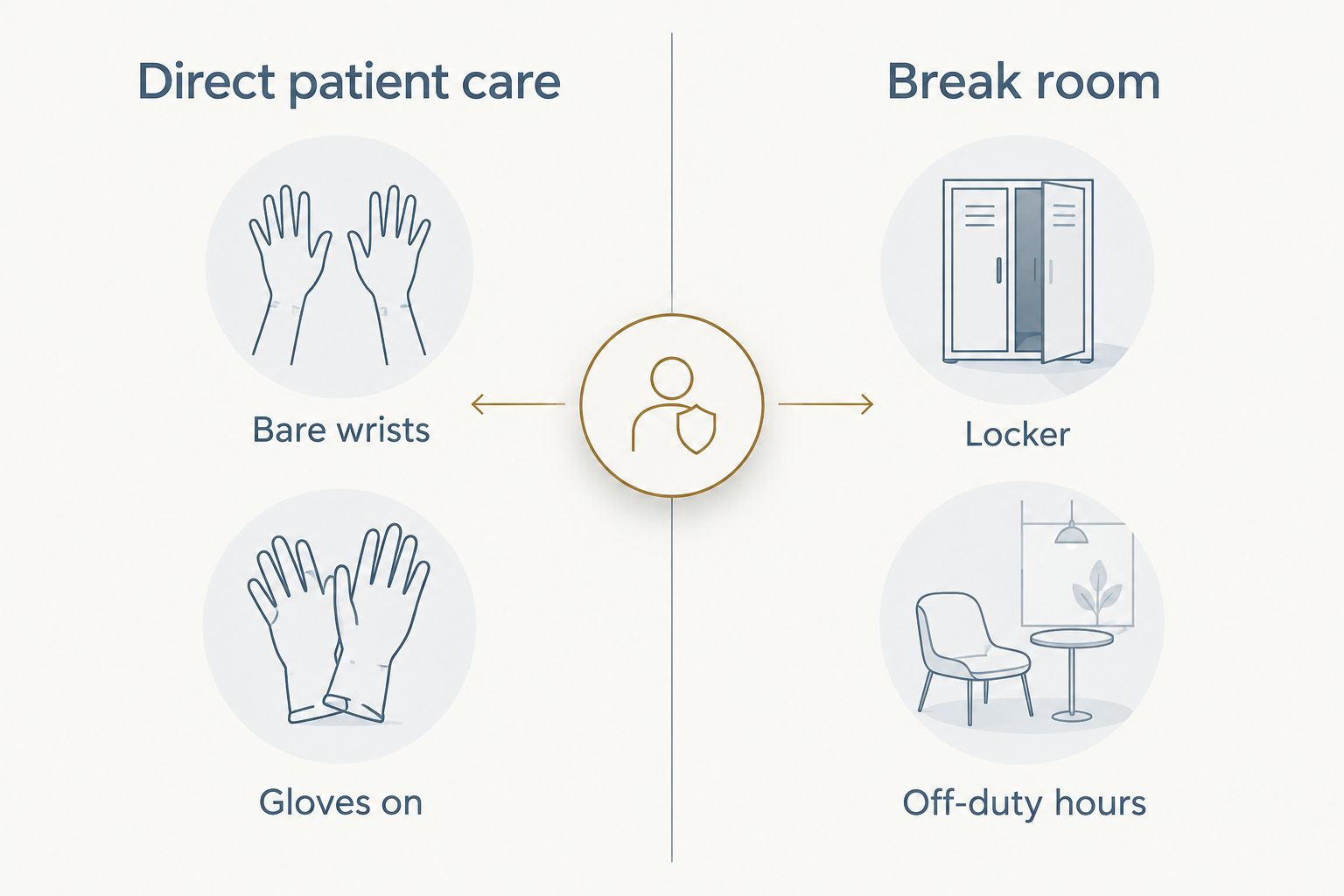
Two-column diagram comparing jewelry rules during patient care versus break room time
A stacking bracelet only has to survive the second column — the first is bare wrists by policy.

Choose adjustable pieces over fixed bangles

An adjustable stacking bracelet closes with a slide knot or an open cuff, not a clasp, which is the single biggest difference between a bracelet a nurse actually wears and one that ends up in a drawer.

  • Pick a slide-knot or pull-tie closure over a lobster clasp or box clasp
  • Test the piece one-handed before buying — you'll be putting it on solo most mornings
  • Avoid anything with a hinge that needs two hands to open under a sleeve cuff
  • Favor cord or thin chain over rigid metal cuffs, since cord flexes around a watch or a badge reel strap
  • Skip charm bracelets with dangling elements that can catch on a glove cuff or bed rail

Match metals to constant hand sanitizer exposure

Hands that get sanitized a dozen times a shift react differently to metal than hands that don't, and that changes which finish is worth paying for.

  • Gold-filled and sterling silver resist tarnish from repeat alcohol-based sanitizer better than gold vermeil or gold-plated pieces
  • Plated finishes wear thin at contact points — the inside curve of a bracelet — faster under daily hand washing
  • Nickel-free metals matter more for nurses than for most buyers, since dry, sanitized skin flags irritation faster
  • Stainless steel and titanium options exist for anyone who wants a stack that never needs polishing
  • Rinse and dry gemstone pieces after a shift instead of leaving sanitizer residue on the setting overnight

Build a stack you can remove in one motion

The test for any nurse's stacking bracelet setup is simple: can you take the whole thing off in the time it takes to reach the sink?
  • Stick to 2-3 adjustable bracelets per wrist so the stack slides off together, not piece by piece
  • Layer thin cord pieces first, then one slightly bolder gemstone piece on top for contrast
  • Avoid stacking a beaded stretch bracelet next to a rigid chain — the elastic snags on the chain links
  • Keep one wrist for the stack and leave the other bare for a watch, pulse check access, or a badge reel
  • Wear the stack low on the wrist, above the wrist bone, so a glove cuff doesn't drag across it all shift
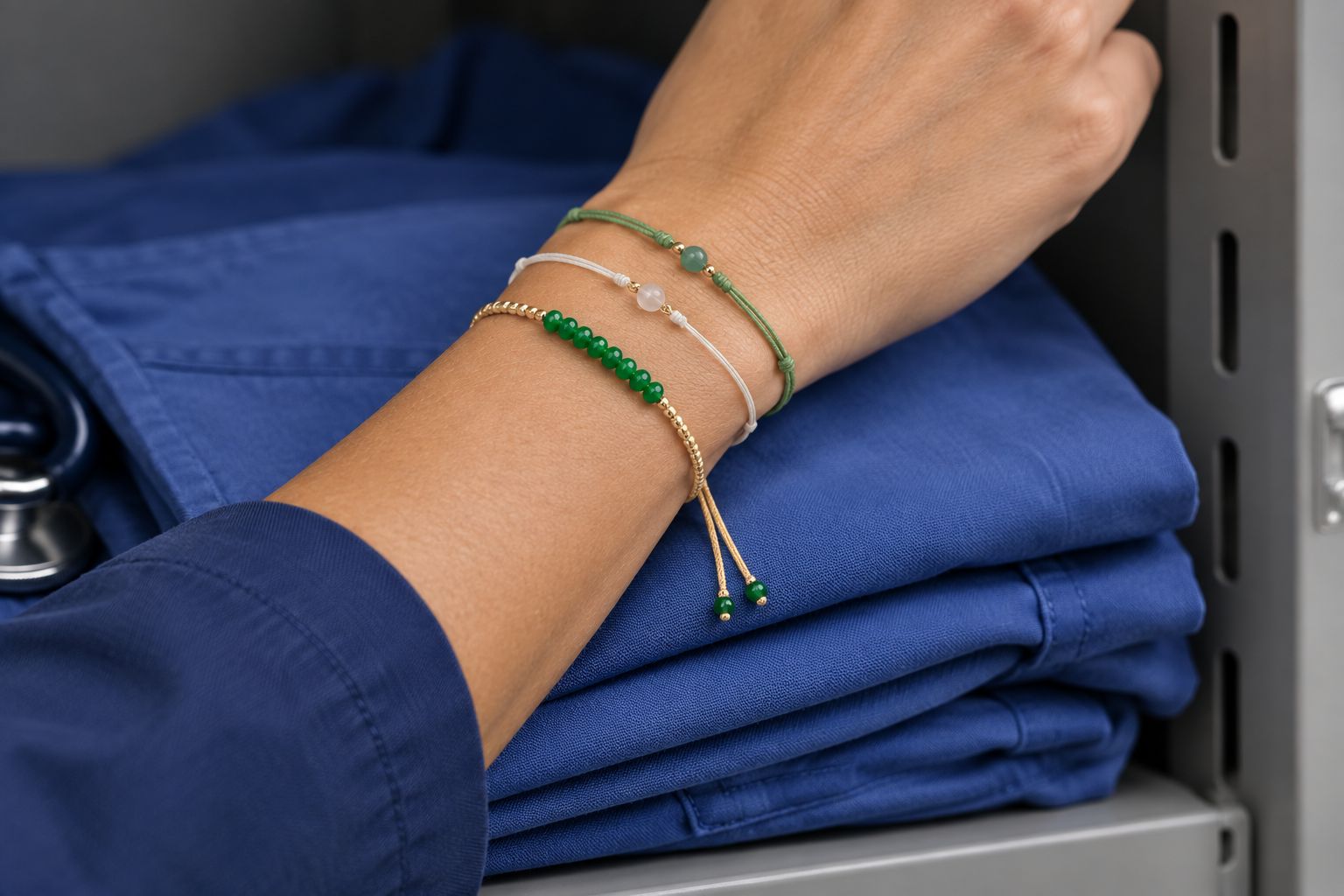
Adjustable green jade stacking bracelet layered with two other thin bracelets on folded scrubs
A stack this size slides off in one motion before a shift starts.
Adjustable stacking bracelets built for one-pull removal
Green Jade Adjustable Stacking Bracelet
Adjustable to fit any wrist, wears alone or stacked.
$49
Blue Chalcedony Adjustable Stacking Bracelet
Adjustable stacking bracelet, simple enough to layer with several others.
$49
Ballet Bracelet
Heart-shaped gemstone piece for the top layer of a stack.
$65

Match gemstones to your shift schedule

A night-shift stack and a day-shift stack don't have to look the same, and picking a color story around your schedule makes the pieces feel purposeful instead of random.

  • Warm stones like carnelian or peridot read brighter for day shifts and morning starts
  • Cooler stones like labradorite or lapis lazuli work for evening and night rotations
  • Pick one anchor stone you rotate every shift and add lighter, thinner bands around it
  • Save a gemstone-heavy piece like Parken Jewelry's green onyx and green jade stacking set for days off, then simplify down for work weeks
  • Keep a single-stone piece as backup for units where policy allows only one visible item

Store your stack somewhere you won't lose it

A locker at a hospital sees more traffic than most jewelry boxes, so storage habits matter more here than almost any other buying decision.

  • Use a small zip pouch clipped inside your bag instead of a loose pocket
  • Keep the stack together as a set so you're not hunting for one piece before a shift
  • Avoid tossing pieces loose into a scrub pocket, where a slide-knot closure can catch on fabric and loosen
  • Do a quick check at the end of each shift that all pieces made it back into the pouch

Comparison: bracelet styles for nurses

Option Best for Key limitation
Adjustable cord/chain stacking bracelet Quick removal before and after a shift Not designed for wear during direct patient care
Fixed bangle Minimalist layering off-duty Slower to remove between quick changes
Beaded stretch bracelet Budget starter stack Elastic stretches with repeat hand washing over time
Chain bracelet with clasp Precise fit, gifting Clasp adds a step during a fast changeover

Verdict: the adjustable cord or chain stacking bracelet wins for nurses in 2026 — it's the only style built to come off and go back on without a fight, multiple times a shift, for years.

Common mistakes nurses make with stacking bracelets

  • Buying fixed bangles first. They look clean in photos but require twisting over the knuckle every single removal, which gets old within a week of shift work.
  • Choosing dangly charm pieces. Anything with hanging elements catches on glove cuffs, bed rails, and IV lines — pick flat or bezel-set stones instead.
  • Ignoring metal sensitivity. Hands dried out from repeat sanitizer flag nickel content faster than normal skin does; gold-filled or sterling silver avoids the issue.
  • Stacking too tall for a scrub sleeve. More than 2-3 pieces bunches up under a cuff and gets in the way of glove changes.
  • Storing pieces loose in a bag. A slide-knot closure loosens against loose fabric and fine chain tangles with badge reels and keys.

FAQ

What's the best type of bracelet for nurses to stack?

An adjustable cord or chain stacking bracelet with a slide-knot closure is the best type for nurses in 2026, since it comes off in one motion instead of fighting a clasp between patients.

Can nurses wear bracelets during patient care?

Most hospitals restrict bracelets, rings, and watches during direct patient care under hand hygiene protocols. Stacking bracelets are built for before and after a shift, not for the floor itself.

Is gold-filled jewelry safe for hands exposed to hand sanitizer all day?

Gold-filled and sterling silver hold up better than gold-plated finishes under daily hand sanitizer use, since the plating on cheaper pieces wears thin at contact points within months.

How many bracelets should a nurse stack on one wrist?

Two to three adjustable bracelets per wrist is the practical cap for nurses. Anything taller bunches under a scrub sleeve and catches on gloves.

Do stacking bracelets work over scrub sleeves?

Thin cord or chain stacking bracelets sit flat enough to wear low on the wrist under most scrub sleeves, but they're typically removed before direct patient care rather than worn under a glove.

What's a good gift for a nurse who likes minimalist jewelry?

An adjustable gemstone stacking bracelet or a Ballet Bracelet works well as a gift for a nurse, since both fit any wrist size and don't require a specific measurement.

Are adjustable bracelets better than bangles for shift workers?

Yes — adjustable bracelets remove in one pull, while bangles require working over the knuckle each time, which adds up over a 12-hour shift with frequent hand washing.

One last thing

The fastest stack to remove has no clasp at all. An adjustable cord tightens and loosens with a single pull, which is why it beats a clasped chain bracelet for anyone taking jewelry off and putting it back on twice in one shift, every shift, in 2026.

Related guides

Leave a comment

Please note, comments must be approved before they are published