Cart
Your cart is empty
Looks like you haven’t added anything yet, browse new arrivals below!
Continue Shopping
Looks like you haven’t added anything yet, browse new arrivals below!
Continue Shopping
So you've seen the term "halo pendant" on a necklace listing and wondered what actually makes it different from any other pendant with a stone on it. Fair question. What is a halo pendant necklace, really? It's a center gemstone (or pearl) ringed by smaller accent stones, beading, or a decorative metal rim, so the main stone sits inside its own little frame of sparkle.
A halo pendant works like this: one focal stone in the middle, surrounded by a ring of smaller details that circle it like, well, a halo. Those details might be tiny pave gemstones, a row of mini accent stones, or just a polished band of metal hugging the outer edge.
The appeal is simple. A halo makes one stone look bigger than it is, and it catches more light from more angles than a plain solitaire ever could. You get more visual presence without needing a larger (and pricier) center stone.
One thing worth clearing up: halo is a style, not a material. It's not a specific metal or a specific gemstone. You'll find halo pendants in gold vermeil, in rhodium-plated silver, set with almost any natural stone you can think of. At Parken, our halo pendants are handmade to order with real natural gemstones and freshwater pearls, which is exactly why no two halos look quite identical. Natural stone just doesn't behave like lab-grown material. It has its own personality.
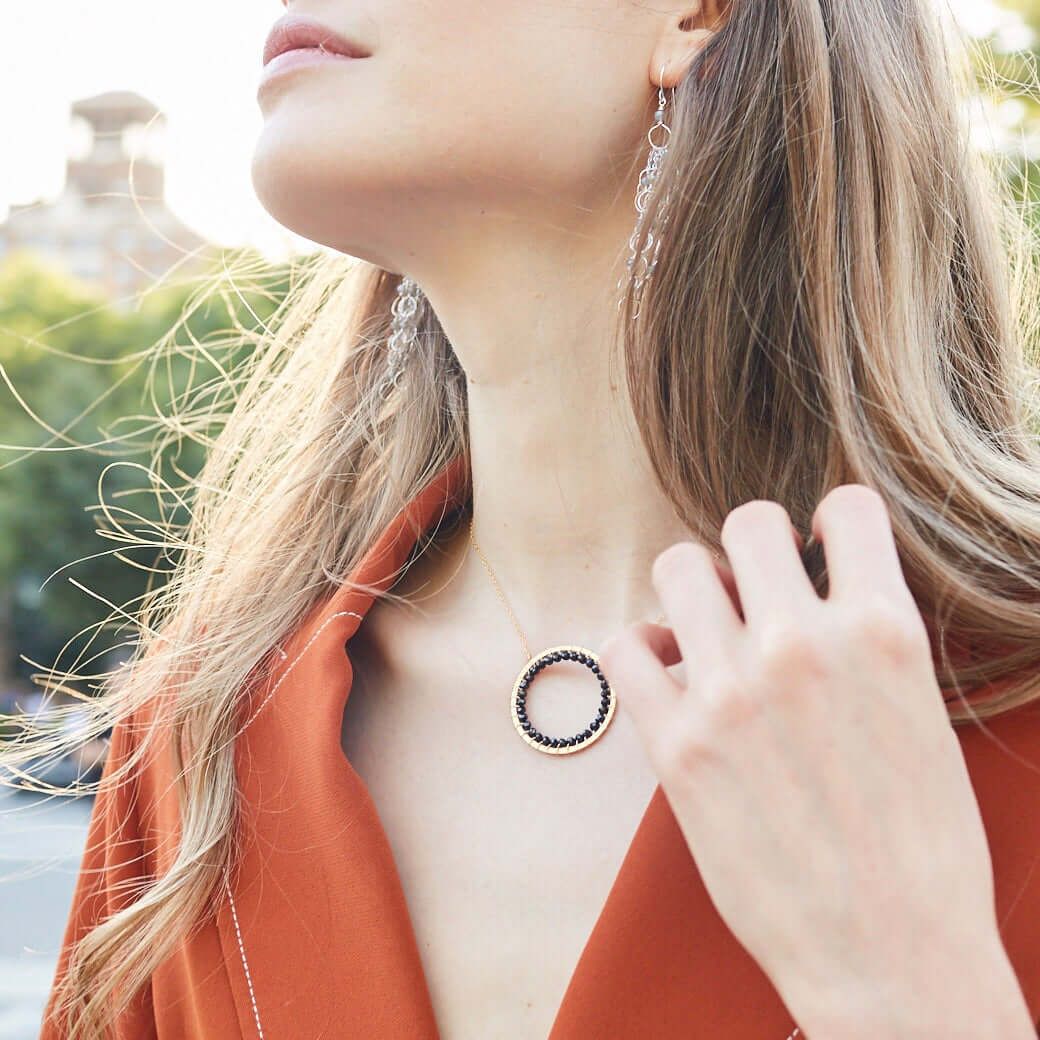
Strip a halo pendant down and you've got three parts. The center stone, set either in a bezel (a smooth metal rim wrapping the edge) or in prongs. The halo ring around it, which can be pave accents, a cluster of mini gemstones, or a plain polished rim. And the bail, the small loop that connects the whole thing to your chain.
Parken makes two main styles of halo. A gemstone halo, where small stones circle the center piece, and a metal halo, where a clean polished rim frames the stone instead. Gemstone halos read a little more dressed up. Metal halos lean more minimal, closer to an everyday pendant with just a bit of extra structure.
Because every piece is made to order and handmade in the USA, the halo setting isn't cast as one mass-produced unit. An artisan places and finishes each ring of stones or metalwork by hand. That matters more than it sounds like it should. It means slight variation from piece to piece, not a flaw, just a sign nobody ran this through an assembly line. Natural stones vary slightly in color and clarity too, so your halo pendant will have its own character. We treat that as the whole point, not something to apologize for.
Halos earn their popularity on practical grounds. More visual impact per carat of actual stone. A flattering frame for colored gemstones especially, since the halo gives the eye somewhere to land before it moves to the main color. And a dressier look than a plain pendant, without the price jump you'd expect from "dressier."
That's part of why halo pendants show up so often in gift searches. Birthdays, anniversaries, milestones. A halo reads as more special, more considered, the kind of thing that doesn't look like it was grabbed last minute. If you're shopping for someone else, browsing gifts for her will turn up more halo styles than you'd expect.
They're versatile too. Short chain, soft color, halo pendants slide right into everyday minimalist layering. Longer chain, bolder stone, suddenly it's doing double duty as an evening piece. Same shape, completely different mood, just depends how you style it.
Here's the honest version: a halo pendant is often the piece someone reaches for on a day they want to feel like themselves. Not an accessory they're wearing because it matches. The one they'd grab first.
It helps to see a halo next to its closest relatives.
A bezel pendant wraps the stone in a smooth metal rim with no ring of accents around it. Cleaner, more minimal, the kind of thing you forget you're wearing by noon. Our bezel necklaces lean into exactly that simplicity.
A solitaire pendant is just the stone on a chain, held by a simple prong or bail, no surrounding detail at all. It's the plainest version of a pendant, which is its own kind of appeal if you want the stone to do all the talking.
A cluster pendant groups multiple stones together rather than framing one center stone with smaller accents. Think several gems sitting side by side, more scattered, less symmetrical than a halo's neat ring.
Quick way to decide: pick halo for more sparkle and presence, bezel for understated daily wear, cluster if you want a more organic, multi-stone look that feels a little less formal.
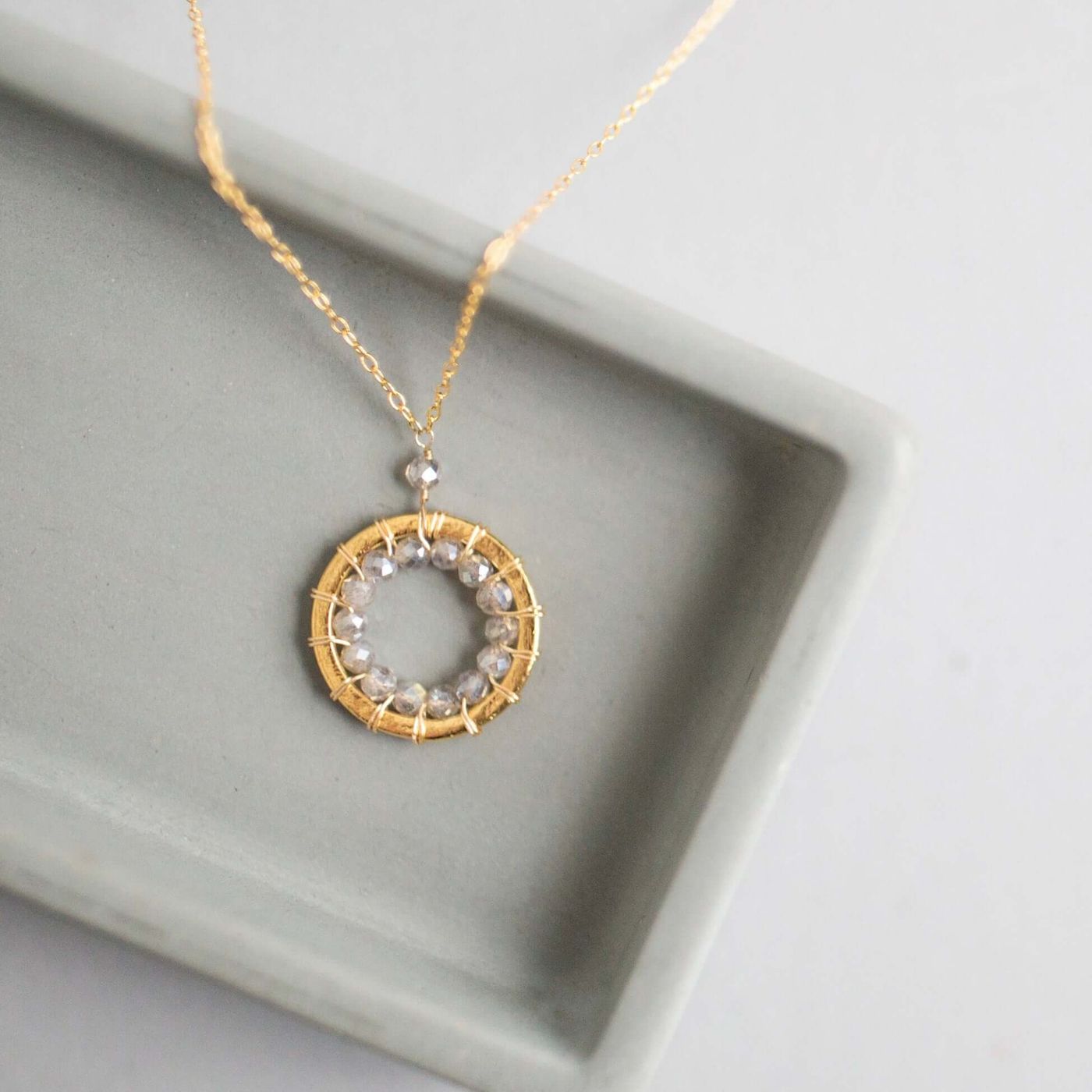
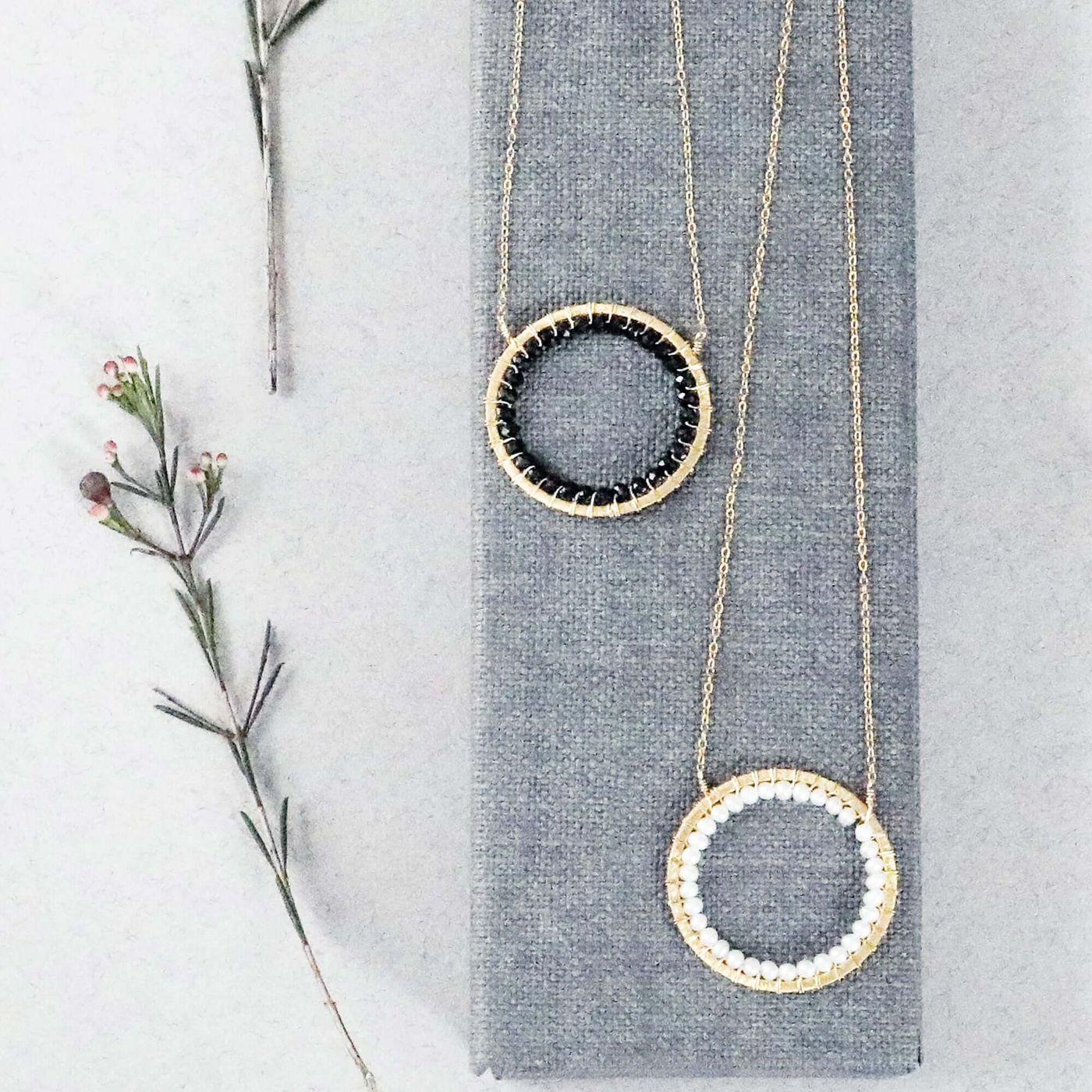
Start with metal. Fourteen karat gold vermeil gives you a warm tone that photographs well against most skin tones. Rhodium-plated silver gives you a cool, white-gold look instead. Match it to whatever you already wear most, since mixed metals on the same neckline can look unintentional if you're not going for that.
Stone choice comes next, and there are two ways to go about it. Pick by birthstone meaning if that's meaningful to you or the person you're gifting for. Or pick by color family: blue tones like London blue quartz or iolite, pink tones like rose quartz or pink tourmaline quartz, neutral sparkle like black spinel if you want something that goes with everything.
Chain length matters more than people think. A 16 to 18 inch chain sits right at or just below the collarbone, which lets the halo pendant be the focal point instead of getting lost in a dip of fabric or competing with other jewelry.
And think about occasion. A bolder gemstone halo makes sense for gifting or evening wear, something with more presence. A smaller mini halo pendant works better for everyday layering, where you want sparkle without a statement.
If you're building a layered look, here's a formula that actually works: a 14 to 16 inch plain chain sitting closest to the neck, your halo pendant on an 18 inch chain as the middle layer, and an optional longer chain or lariat behind it for depth. Our layering chains are built for exactly this kind of stacking.
Leave about two inches of space between each layer. Any closer and the halo pendant competes with the shorter chain or tangles with it every time you move. That breathing room is what keeps the halo as the clear focal point.
A single halo pendant on its own works just as well, especially with higher necklines or when you want one clean focal point instead of a full layered look. Not every outfit needs three chains.
On metal tones: keeping everything in the same metal, all gold or all silver, gives you a cohesive, put-together look. Mixing metals on purpose gives a more collected-over-time feel, like each piece has its own story. Both are fine. It's just a choice, not a rule.
Gold pieces are 14k gold vermeil over sterling silver. Silver pieces are rhodium plated over sterling silver. Both are designed to be tarnish resistant, but "resistant" isn't the same as indestructible, so a little care goes a long way.
Take it off before you shower, swim, or apply lotion and perfume. Plating lasts longest when it's kept away from water and chemicals, full stop.
Store it flat or hanging rather than tossed in a drawer with other pieces. A halo setting has small prongs or accent stones that can catch on other jewelry and bend if you're not careful.
For specifics on how long a made-to-order piece takes to ship, or what the return window looks like, check our shipping policy and return policy rather than guessing. Those details change based on stone availability, so it's worth a quick look before you order.
No. A solitaire pendant is just one stone hanging on a chain with a simple setting, while a halo pendant surrounds that center stone with a ring of smaller accent stones or decorative metalwork. The halo makes the center stone look larger and adds more sparkle, which is the main difference between the two styles.
Halo pendants can be made in warm gold tones or cool silver tones. At Parken, our gold pieces are 14k gold vermeil, which is gold plating over fine Italian .925 sterling silver, and our silver pieces are rhodium plated over that same sterling silver base for a tarnish resistant, white gold look.
Yes, many people wear halo pendants daily, especially smaller or mini halo styles on an 18 inch chain. Like any plated jewelry, it's best to take it off before showering, swimming, or applying lotion and perfume so the plating lasts as long as possible.
A 16 to 18 inch chain is the most versatile length for a halo pendant, since it sits at or just below the collarbone and keeps the pendant as the clear focal point. If you're layering it with other necklaces, pair it with a shorter 14 to 16 inch chain worn closer to the neck.
Halo pendants are a popular gift choice because the extra sparkle and detail make them feel more special than a plain pendant, without a big jump in price. A birthstone colored halo pendant is an easy way to make the gift feel personal to the person receiving it.
So, what is a halo pendant necklace, in one line? A center stone framed by a ring of accents or metalwork, built to give you more sparkle without any extra fuss in how you wear it.
If you want to see what that looks like in person, take a look through Parken's halo pendant collection and find a stone and metal that fits the way you actually get dressed, or the person you're shopping for. And if you'd rather hear about new halo styles and gemstone restocks before they're gone, join our newsletter. No pressure either way.

Subscribe to our email list to get early access to new arrivals and exclusive offers.
Leave a comment