Cart
Your cart is empty
Looks like you haven’t added anything yet, browse new arrivals below!
Continue Shopping
Looks like you haven’t added anything yet, browse new arrivals below!
Continue Shopping
To stack bracelets without tangling, start with a small stack, keep each bracelet comfortably fitted, and avoid pairing several loose, delicate chains that slide across one another. Add bracelets individually, separate dangling details from neighboring links, and check the arrangement while moving your wrist. These steps reduce crossing and snagging; they do not make every combination tangle-proof.
Build your stack around fit and movement, not just matching colors. A bracelet that looks neatly separated on a table can cross its neighbor once you reach, type, or pull on a sleeve.
If you are choosing pieces for a 2026 jewelry refresh, use the best stacking bracelets guide for style ideas, then check how your chosen pieces behave together. Appearance is the starting point. Comfort decides what stays on your wrist.
This check should feel simple. You are looking for a stack you can wear without repeatedly stopping to rearrange it, not a perfectly still arrangement.
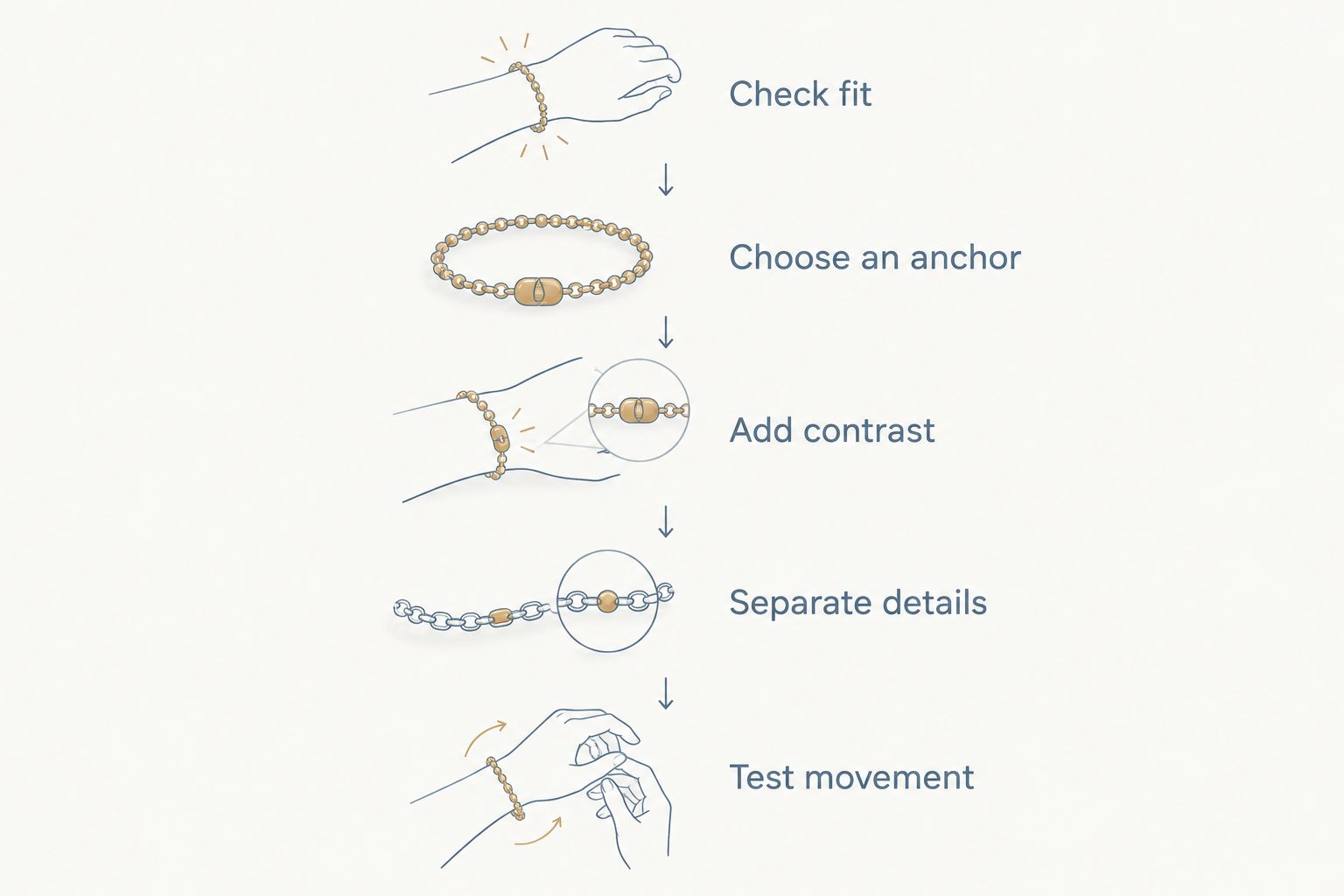
A tangled stack is not just an untidy stack. Pulling linked pieces apart puts tension on chains, clasps, and decorative connections, while repeated rubbing deserves attention when you wear gemstones beside metal.
Parkenjewelry makes handmade minimalist gemstone jewelry in New York City. For that kind of jewelry, thoughtful stacking means letting the stones remain visible and avoiding combinations that need constant adjustment.
For your 2026 everyday stack, choose ease over quantity. If you keep separating the same bracelets, change the combination rather than accepting the snagging.
Choose by construction first, then color. A flexible chain, a rigid bangle, and a bracelet with dangling details move differently, even when they share a similar finish.
The table below compares general bracelet types, not tested products. Your actual fit, links, settings, and clasps still determine whether a pairing works.
| Pairing | Best for | Practical advantage | Limitation to check |
|---|---|---|---|
| Flexible chain and smooth bangle | A simple mixed-texture stack | Contrasting structures make it easier to see whether the chain is crossing | The bangle can move over the chain or rub against decorative details |
| Two fine chains | A delicate, minimal look | Keeps the overall appearance light | Loose chains can overlap, and links or extension tails can catch |
| Gemstone bracelet and plain bracelet | Keeping a gemstone as the focal point | The simpler piece leaves the stone visually clear | Metal rubbing against exposed stones or settings needs attention |
| Two smooth bangles | A structured stack without interlocking chain links | No fine chain links to thread through one another | Bangles still slide, touch, and make noise |
| Charm bracelet and plain bracelet | Giving meaningful charms room to show | Keeps the neighboring piece visually simple | Dangling charms can catch on clasps, links, or sleeves |
The easiest pairing is the one that passes your movement check. A smooth design is not automatically comfortable, and a delicate design is not automatically troublesome. Test the pieces you own rather than buying around a rule that ignores their construction.
Best for: everyday wear and learning which pieces work together. Choose 2 bracelets as a starting recommendation, not a fixed limit. Pair your favorite piece with a simpler companion and watch where they meet.
Put the decorative bracelet on first, then add the companion without letting either pass through the other. With flexible bracelets, check the clasp area as carefully as the front. An extension tail can cause trouble even when the visible part of the stack looks tidy.
The advantage is easy troubleshooting. If something catches, you can identify the contact point without sorting through a crowded arrangement. The limitation is that even a small stack can tangle when both pieces are loose or have details that interlock.
For a low-maintenance 2026 look, keep this pairing if it feels comfortable during ordinary movement. You do not need an extra bracelet to make the stack feel finished.
Best for: a fuller look when your first pairing already works. Add a third bracelet only after wearing the initial combination comfortably. This is a styling recommendation, not a promise that 3 bracelets will stay separate.
Give the new bracelet a clear purpose: a different texture, a plain outline, or a color you want to repeat. Avoid adding another dangling element simply because there is space on your wrist.
The benefit is more room for self-expression. The drawback is another set of contact points to check. If your third piece pushes the others over one another, return to the smaller stack or move it to the opposite wrist.
Keep enough freedom to bend your wrist naturally. A stack should not pinch your skin, restrict movement, or rely on tightness to hold everything in position.
Tangling begins where one piece crosses or catches another. Look at the exact trouble spot instead of assuming every bracelet needs replacing.
Clasp placement helps you spot catching, but it is not a permanent lock. Bracelets rotate as you move. Choose pieces that work when they shift, not only when you arrange them perfectly.
Yes, you can wear gemstone and metal bracelets together, but check where the metal touches the stone or its setting. A plain companion keeps the gemstone visually clear; it does not eliminate rubbing.
Look at exposed edges, protruding settings, and any place a rigid bracelet presses against a decorative element. If contact is repeated, change the order, replace the companion, or wear the pieces on separate wrists.
For a handmade option, Parkenjewelry's Ballet Bracelets feature a heart-shaped gemstone. Best for: women who want a gemstone detail as the focal point of a minimalist stack. The decorative feature gives you something to build around, but the product name alone does not establish its fit beside your existing bracelets; check the product details and test the pairing.
Start with clasps separated so you can see whether a clasp or extension tail is catching another bracelet. Then move your wrist and check again, because the starting position will not necessarily stay in place.
Do not fasten separate bracelets together unless their construction specifically supports that use. Attaching one clasp to another can change the fit and place tension on parts that were not intended to carry the whole stack.
A 2026 bracelet refresh does not require a connector or special accessory. First solve the basic issues: fit, catching details, and a pairing that stays comfortable during movement.
Stop pulling and support the tangled area. If you can reach a clasp without straining the jewelry, open it and remove the affected bracelet before separating the pieces.
Work on a clean, well-lit surface where a small component will not disappear. Lay the bracelets down, identify the crossing point, and gently reverse the path that caused the catch. Avoid tugging both ends in opposite directions.
Do not force a knot, twist a setting, or use a sharp tool against a gemstone. If a chain is tightly knotted or a component looks bent, take it to a jeweler rather than turning a snag into damage.
Afterward, inspect the pieces before wearing them again. A repeated catch at the same point is a reason to change the pairing or have that component checked.
Remove bracelets individually instead of sliding the entire stack off as a bundle. Lay each piece down separately so you can see that nothing remains threaded through another chain.
Store bracelets in separate compartments or soft pouches, with clasps closed where appropriate. Do not leave delicate chains mixed with loose charms, earrings, or other pieces that can catch their links.
Choose cleaning methods for the exact metal and gemstone, not for the stack as a whole. Jewelry that looks similar can have different care needs, so check the maker's instructions before soaking or applying a cleaning product.
Make this your 2026 care habit: inspect the clasp and contact points while putting jewelry away. It is easier to notice a problem when each bracelet is lying separately than when everything is piled together.
What's the best way to stack bracelets without tangling?
Start with a small, comfortably fitted stack, separate dangling details, and test the bracelets while moving your wrist. Change any pairing that repeatedly crosses or catches rather than trying to hold it in a perfect position.
How many bracelets should I stack at first?
Start with 2 bracelets as a practical styling recommendation. Add another only after the first pairing feels comfortable and does not repeatedly catch during ordinary movement.
Is a bangle better than another chain for bracelet stacking?
A smooth bangle offers a different structure from a flexible chain, but it is not automatically better. Check whether it slides over the chain or rubs against a gemstone or setting.
Should stacked bracelets all be the same length?
Stacked bracelets do not need identical lengths; each needs a comfortable fit on your wrist. Compare how the actual pieces sit and move rather than choosing by listed length alone.
Can I stack a gemstone bracelet with a plain gold-colored bracelet?
You can pair a gemstone bracelet with a plain bracelet, provided the contact points do not repeatedly rub or catch. Color does not tell you the metal composition or the care each piece needs.
Are Parkenjewelry bracelets suitable for a minimalist stack?
Parkenjewelry sells handmade minimalist gemstone jewelry, including bracelets. Choose a bracelet as your focal piece, then check its dimensions, construction, and fit beside the jewelry you already own.
Can I sleep in a bracelet stack to keep it together?
Remove and store bracelet stacks separately before sleeping. Keeping the pieces together overnight does not prevent crossing, snagging, or pressure on decorative details.
What should I do if the same bracelet keeps snagging?
Inspect the exact snagging point and stop wearing the bracelet if a link, clasp, or setting looks damaged. If the components look intact, try a different companion or wear the bracelet alone.
The back of your wrist deserves as much attention as the front. A stack can look beautifully simple from above while extension tails and clasps catch underneath.
Before leaving, turn your wrist over and check that hidden side. If you have to tuck the same loose end away repeatedly, change the pairing. Your jewelry should feel personal, not like another task on your list.

Subscribe to our email list to get early access to new arrivals and exclusive offers.
Leave a comment